
Form-Finding for RFEM 6
by Dlubal, Structural analysis
Equilibrium shapes of membranes, cable structures and air-supported structures in RFEM 6
Dlubal programs and add-ons
RFEM 6 is the main program; add-ons are bought separately, whenever you need them. Click an add-on to see what it does and its price.
Main programs 4
-
RFEM 6
Finite element structural analysis for civil engineers
from 3.325 €
- Method: finite elements
- Elements: bars, plates, shells, solids
- Design: with add-ons (concrete, steel, timber, glass)
-
RSTAB 9
Structural analysis of frames and trusses for civil engineers
from 1.842,50 € per year
- Structures: bars, frames, trusses
- Analysis: linear and non-linear
- Design: with add-ons
-
RSECTION 1
Section properties and stress checks for thin-walled and solid sections
1.855 €
- Purpose: cross-section properties, stresses
- Cross-sections: thin-walled and solid
- Import: DXF, CAD tools, script
-
RWIND 3
Digital wind tunnel CFD for wind loads on buildings and structures
from 2.880 €
- Method: CFD, digital wind tunnel (OpenFOAM®)
- Editions: Basic, Pro
- Basic: steady flow, RAS k-ε, k-ω turbulence
Design 10
-
Steel Design
Strength, stability and serviceability checks of steel members in RFEM 6
2.065 €
- Limit states: ultimate and serviceability
- Standards: Eurocode 3, AISC 360, CSA S16 and others
- Sections: rolled, hollow, parametric, composite, from RSECTION
-
Stress-Strain Analysis
Stress analysis of members, surfaces and solids against limit stresses
945 €
- Objects: members, member sets, surfaces, solids
- Stresses: normal, shear, principal, membrane, equivalent
- Equivalent stress: von Mises, Tresca, Rankine, Bach
-
Concrete Design
Reinforced concrete in RFEM 6: members, surfaces, columns and punching shear
2.065 €
- Elements: members, member sets, surfaces and columns
- Limit states: ultimate and serviceability, with the detailing rules of the standard
- Reinforcement: longitudinal, shear and torsional per member, design strips on surfaces
-
Concrete Foundations
Geotechnical checks and design of concrete foundations inside RFEM 6
875 €
- Foundation types: reinforced and unreinforced plates, bucket and block foundations
- Geotechnical checks: bearing capacity, sliding, uplift, overturning
- Standards: Eurocode 7, Eurocode 2, ACI 318, IBC
-
Tendons
Realistic modelling of prestressed and post-tensioned tendons in RFEM 6
1.316 €
- Geometry: free 3D definition of tendons
- Internal forces: statically determinate and indeterminate from prestressing
- Assignment: automatic to members, member sets and ribs
-
Aluminum Design
Strength, stability and serviceability checks of aluminium members in RFEM 6
1.365 €
- Limit states: ultimate and serviceability
- Standards: EN 1999-1-1, ADM 2020 and others
- Section resistance: tension, compression, bending, shear, torsion, combinations
-
Glass Design
Design of single and laminated glass panes in RFEM 6
1.295 €
- Panes: single and laminated
- Standards: DIN 18008, ASTM E1300 or no standard
- Geometry: flat and curved panes
-
Masonry Design
Finite element design and checking of masonry in RFEM 6
1.295 €
- Method: finite elements, macro-modelling
- Material model: elastic-plastic after Lourenço (Rankine and Hill)
- Checks: walls in compression and shear
-
Timber Design
Strength, stability, serviceability and fire checks of timber structures in RFEM 6
1.505 €
- Limit states: ultimate, serviceability and fire
- Standards: EN 1995, NDS, CSA O86, SIA 265 and others
- Elements: members and surfaces of timber and wood-based materials
-
Multilayer Surfaces (such as Laminate, CLT)
Multilayer surfaces such as CLT and laminate, with your own layer build-up
1.155 €
- Program: RFEM 6 (add-on)
- Applications: CLT, laminate, textile-reinforced concrete, glass panes, fibre-reinforced plastics
- Layers: free build-up, graphic display of orientation
Connections 2
-
Steel Joints
Finite element analysis and design of steel connections inside RFEM 6
1.855 €
- Method: CBFEM, finite element model in the background
- Standards: EN 1993-1-8, AISC 360-22, AISC 360-16, CSA S16-24
- Components: plates, bolts, welds, base plates with anchors
-
Components
Design of construction products such as joist hangers and tension rods inside RFEM 6
1.015 €
- Products: studs, joist hangers, cables, tension rods, etc.
- Assignment: to members and member ends
- Forces: transferred automatically from the calculation
Dynamic analysis 4
-
Modal Analysis
Natural frequencies, periods and mode shapes of your structure in RFEM 6
945 €
- Program: RFEM 6 (add-on)
- Results: eigenvalue, angular frequency, natural frequency, period
- Mode shapes: graphical display and animation in the model
-
Response Spectrum Analysis
Seismic analysis with response spectra and equivalent static loads in RFEM 6
1.085 €
- Program: RFEM 6 (add-on)
- Methods: response spectrum, equivalent static loads
- Spectra: EN 1998-1 (25+ National Annexes), ASCE 7, NBC and others
-
Time History Analysis
Time-domain dynamic analysis: earthquakes, vibrations, blast, moving loads
1.015 €
- Program: RFEM 6 (add-on)
- Analysis types: accelerogram, time diagram
- Solvers: linear modal, linear and nonlinear implicit Newmark
-
Pushover Analysis
Pushover analysis: capacity curve and target displacement to Eurocode 8
1.015 €
- Program: RFEM 6 (add-on)
- Plastic hinges: steel to FEMA 356 and EN 1998-3
- Nonlinear material: masonry, bilinear steel, your own curves
Additional analyses 7
-
Nonlinear Material Behavior
Nonlinear material models in RFEM 6: plasticity, damage and cracking
1.155 €
- Program: RFEM 6 (add-on)
- Calculation: iterative, with stiffness adjustment
- Isotropic models: plastic, nonlinear elastic, damage
-
Structure Stability
Critical load factors and buckling modes of the whole structure in RFEM 6
1.015 €
- Methods: eigenvalue and incremental (nonlinear)
- Elements: members, shells, solids
- Eigenvalue solvers: Lanczos, roots of characteristic polynomial, subspace iteration
-
Construction Stages Analysis (CSA)
Stage-by-stage analysis of the construction process for members, surfaces and solids
1.225 €
- Elements: members, surfaces, solids
- Stages: defined and displayed in the RFEM model
- Changes per stage: add, remove, modify, reactivate
-
Torsional Warping (7 DOF)
Cross-section warping as a 7th degree of freedom in RFEM 6 member analysis
1.225 €
- Degrees of freedom: 7 (ux, uy, uz, φx, φy, φz, ω)
- Internal forces: 8, including Mt,pri, Mt,sec and bimoment Mω
- Analyses: linear static, second-order, large deformation
-
Time-Dependent Analysis (TDA)
Creep, shrinkage and ageing of concrete over time in RFEM 6
805 €
- Program: RFEM 6 (add-on)
- Effects: creep, shrinkage, ageing
- Elements: members and surfaces
-
Form-Finding
Equilibrium shapes of membranes, cable structures and air-supported structures in RFEM 6
1.610 €
- Program: RFEM 6 (add-on)
- Elements: members with axial force, membrane surfaces in tension
- Method: Updated Reference Strategy (URS)
-
Geotechnical Analysis
Soil from boring logs, piles and soil-structure interaction inside RFEM 6
1.155 €
- Program: RFEM 6 (add-on)
- Soil data: soil samples from boring logs
- Soil massif: automatic, with layer boundaries and groundwater
Special solutions 3
-
Model Optimization & Costs
Optimisation of parametric models in RFEM 6 with particle swarm optimisation (AI)
1.155 €
- Program: RFEM 6 (add-on)
- Methods: particle swarm optimization (PSO), batch processing
- Criteria: minimum weight or minimum deformation
-
Building Model
Stories, diaphragms and stability of multi-storey buildings in RFEM 6
1.365 €
- Program: RFEM 6 (add-on)
- Stories: building defined by stories, with settings per story
- Diaphragms: rigid, semi-rigid, flexible or none
-
WebService & API
Programmable interface for RFEM 6, RSTAB 9 and RSECTION 1, with Python and C#
1.090 € per year
- Programs: RFEM 6, RSTAB 9, RSECTION 1
- Technology: WebService with SOAP, request and response communication
- Languages: high-level libraries for Python and C#
Services 1
-
Service Contract
Support and updates contract for RFEM 6, RSTAB 9, RSECTION 1 and RWIND 3
on request
- Levels: Basic, Pro
- Term: 1 year
- Programs: RFEM 6, RSTAB 9, RSECTION 1, RWIND 3
First-licence prices for Greece and Cyprus, excluding VAT. The add-ons work inside RFEM 6.
The shape that balances itself
See how you define the prestress, how the form is found and what you do next with the geometry.
Prestress in a single load case
The “Prestress” load case becomes a form-finding analysis for the whole model.
- Form-finding loads for members, surfaces and solids, together with regular loads
- Isotropic or orthotropic prestress, in a Cartesian or radial system
- Fabric and Foil materials, and a fabric model with RVE microstructure
- Conditions for members: unstressed length, maximum sag, forces at the ends


Equilibrium with the Updated Reference Strategy
The mesh geometry moves until the sag, force and prestress conditions are met.
- Anticlastic, synclastic and combined shapes
- Tension method for planar shapes, projection method for conical ones
- Self-weight and pneumatic pressure in the same calculation
- Parallel form-findings in the same model


Air-supported structures and cushions
The shape is found from the equilibrium between prestress and internal pressure.
- Gas pressure loads and an ideal gas inside the membrane envelope
- Multi-layer cushions with the ideal gas law
- The geometry goes into the full analysis, with combinations and construction stages


Initial state for the whole analysis
The form found, with its forces, becomes the starting point of the rest of the calculation.
- Automatic assignment of the initial state via the combination wizards
- Member lengths in the loaded and unloaded states
- Coloured coordinate and inclination plots of the shape
- Geometry ready for wind loads in RWIND


Form-finding and calculation of membranes
Official Dlubal webinar on form-finding and calculation of membrane structures in RFEM 6.

See it in action
The video or demo loads only when you press play.
What it does, stage by stage
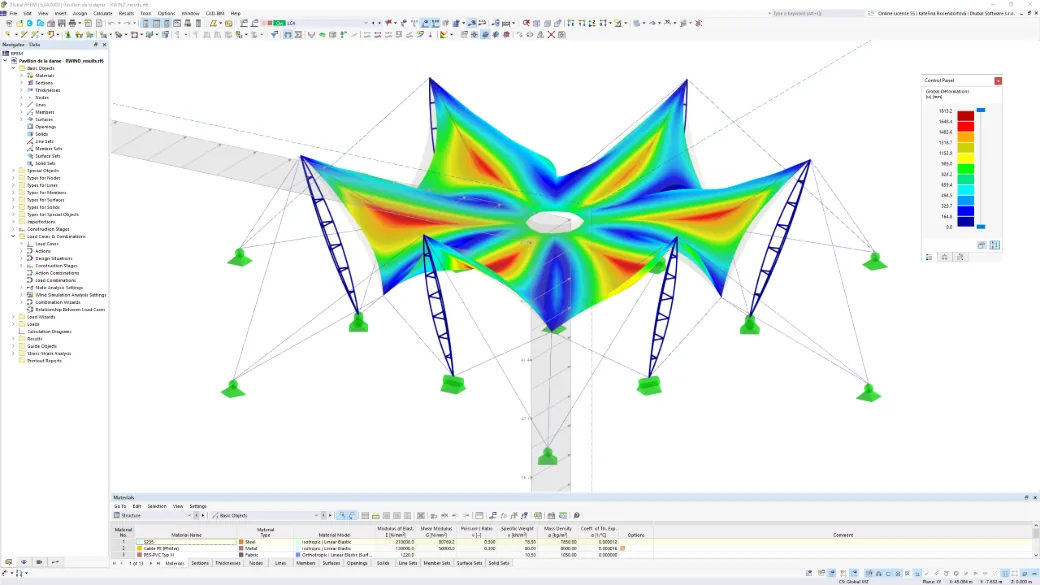
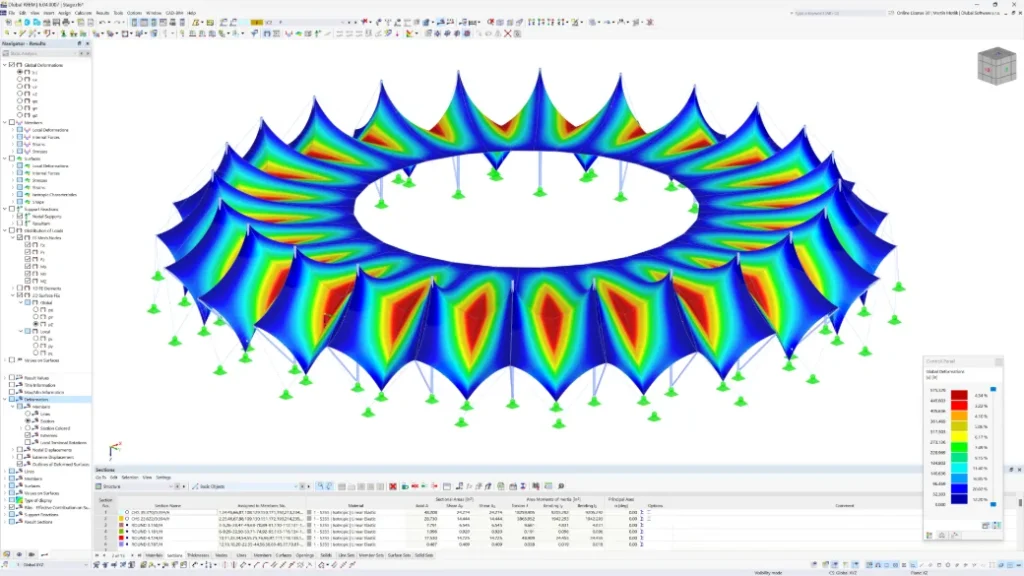
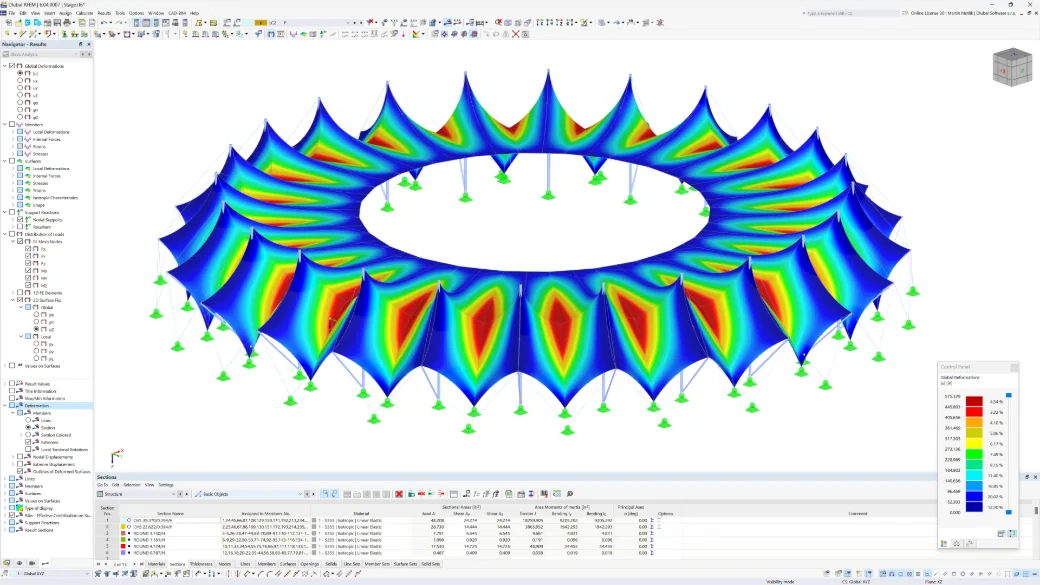
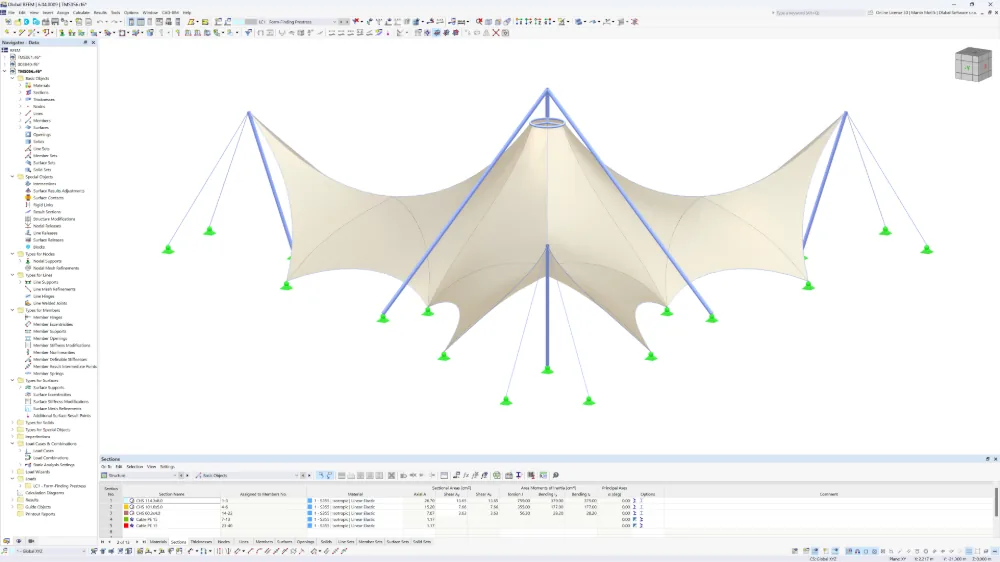
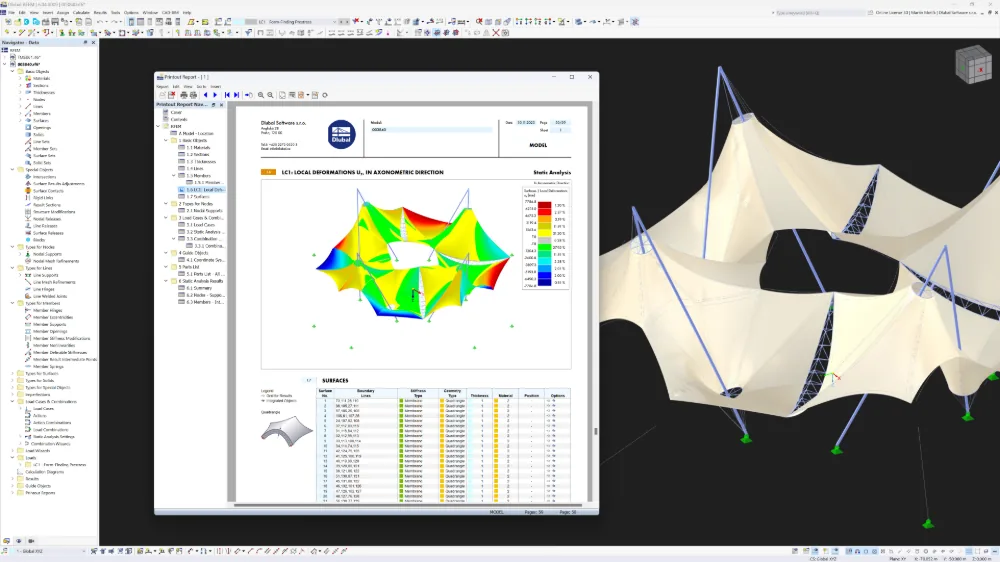
The Form-Finding for RFEM 6 add-on finds the optimal shape of members subjected to axial forces and of membrane surfaces loaded in tension. The shape results from the equilibrium between the axial force in the members or the membrane stress and the boundary conditions you define.
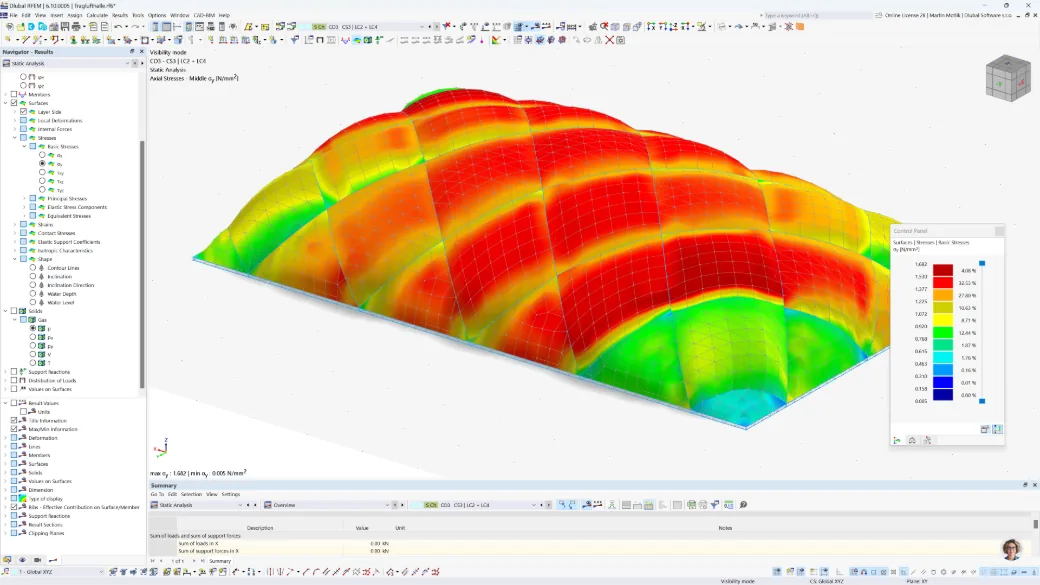
You activate the add-on in the model’s Base Data. Load cases of the “Prestress” category, together with special form-finding loads for members, surfaces and solids, become a form-finding analysis for the whole model. You can simulate mechanical and pneumatic prestress, isotropic or orthotropic, in a Cartesian or radial coordinate system, as well as multi-layer foil cushions with the ideal gas law between the layers.
The calculation uses the Updated Reference Strategy (URS) method, which moves the mesh geometry until the shape meets the sag, force and prestress conditions. Regular loads such as self-weight or pneumatic pressure are also taken into account, so you can find anticlastic and synclastic shapes. You choose the tension method for planar shapes or the projection method for conical shapes with horizontal restraints.
The resulting shape, with its forces, is stored as the initial state for the rest of the structural analysis and is assigned automatically to the design situations via the combination wizards. The geometry can also be used to determine wind loads in the RWIND digital wind tunnel. Typical applications are tensile membranes, cable structures and air-supported structures.
Features
Features
- Program
- RFEM 6 (add-on)
- Elements
- members with axial force, membrane surfaces in tension
- Method
- Updated Reference Strategy (URS)
- Options
- tension method, projection method
- Prestress
- mechanical and pneumatic, isotropic or orthotropic
- Shapes
- anticlastic, synclastic and combined
- Foil cushions
- multiple layers, ideal gas law
- Materials
- Fabric and Foil types in the material library
- Result
- initial state for the rest of the analysis
All features
- Finding the optimal shape of members subjected to axial forces and tension-loaded surface models
- Shape determined by the equilibrium between member axial force or membrane stress and the boundary conditions
- New model shape with active force conditions as a universally applicable initial state for the entire structure
- Simulation of a mechanical and pneumatic prestress
- Consideration of isotropic and orthotropic prestresses on Cartesian or radial coordinate systems
- Finding stress-harmonic planes, synclastic, anticlastic, or combined shapes
- Simulation of multi-layer foil cushions, considering the ideal gas law between the layers
- Form-found overall model geometry available for determining wind loads via an optional wind analysis in RWIND
- Load cases of the "Prestress" category with form-finding loads for members, surfaces, and solids
- Calculation with the Updated Reference Strategy (URS) method, complying with the specified sag, force, and prestress
- Consideration of regular forces, such as self-weight or pneumatic pressure
- Two methods: the tension method for planar shapes and the projection method for conical shapes with horizontal restraints
- Geometric and force-based specifications for the form-finding of member components
- Nonlinear material models and multi-stage form-finding processes
- Graphical evaluation of the shape using colored coordinate and inclination plots
- Automatic assignment of the initial state, with results displayed in the original and the deformed state
System requirements
Operating system Windows
- Requires an RFEM 6 licence
- For sequential form-finding states per construction stage: also the Construction Stages Analysis (CSA) add-on
- For wind loads on the form-found geometry: optionally RWIND
Works well with, and alternatives
Works well with

Form-Finding for RFEM 6 next to alternatives
Open the full comparisonQuestions, licence and delivery
Which structures is it for?
For tensile membranes, cable structures and members with axial force, as well as pneumatic and air-supported structures.
How do I define form-finding?
You activate the add-on in the Base Data and use a load case of the “Prestress” category with form-finding loads. All boundary conditions are defined in one load case.
What happens to the form-found shape?
It is stored as an initial state and assigned automatically, via the combination wizards, to all load situations of a design situation.
Does it support pneumatic structures?
Yes. It simulates pneumatic prestress with gas pressure loads, an ideal gas inside a membrane envelope and multi-layer cushions.
Can I have several form-findings in one model?
Yes, parallel form-findings in one model, and sequential states in combination with the Construction Stages Analysis (CSA) add-on.
Which results do I see for members?
The result navigator and tables show the lengths of members after form-finding, in the loaded and unloaded states.
How do I receive the licence?
After payment we order the licence from the manufacturer and email you its details.
Do the prices include VAT?
Prices exclude VAT. With a valid VAT number from another EU country, VAT is not charged; in Belgium it is charged at 21%. For private customers, VAT is calculated at checkout.