
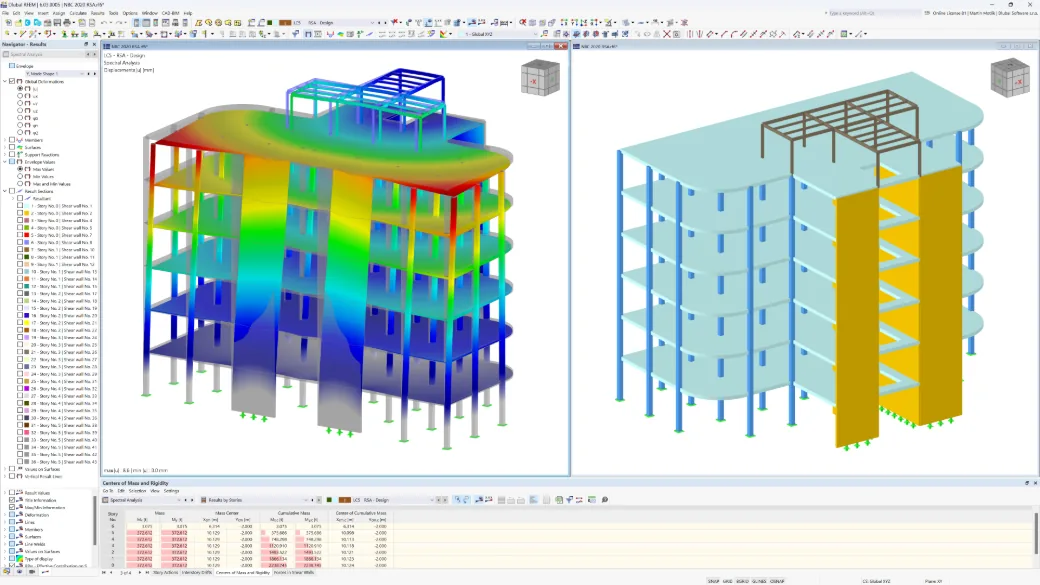
Concrete Design for RFEM 6
by Dlubal, Structural analysis
Reinforced concrete in RFEM 6: members, surfaces, columns and punching shear
Dlubal programs and add-ons
RFEM 6 is the main program; add-ons are bought separately, whenever you need them. Click an add-on to see what it does and its price.
Main programs 4
-
RFEM 6
Finite element structural analysis for civil engineers
from 3.325 €
- Method: finite elements
- Elements: bars, plates, shells, solids
- Design: with add-ons (concrete, steel, timber, glass)
-
RSTAB 9
Structural analysis of frames and trusses for civil engineers
from 1.842,50 € per year
- Structures: bars, frames, trusses
- Analysis: linear and non-linear
- Design: with add-ons
-
RSECTION 1
Section properties and stress checks for thin-walled and solid sections
1.855 €
- Purpose: cross-section properties, stresses
- Cross-sections: thin-walled and solid
- Import: DXF, CAD tools, script
-
RWIND 3
Digital wind tunnel CFD for wind loads on buildings and structures
from 2.880 €
- Method: CFD, digital wind tunnel (OpenFOAM®)
- Editions: Basic, Pro
- Basic: steady flow, RAS k-ε, k-ω turbulence
Design 10
-
Steel Design
Strength, stability and serviceability checks of steel members in RFEM 6
2.065 €
- Limit states: ultimate and serviceability
- Standards: Eurocode 3, AISC 360, CSA S16 and others
- Sections: rolled, hollow, parametric, composite, from RSECTION
-
Stress-Strain Analysis
Stress analysis of members, surfaces and solids against limit stresses
945 €
- Objects: members, member sets, surfaces, solids
- Stresses: normal, shear, principal, membrane, equivalent
- Equivalent stress: von Mises, Tresca, Rankine, Bach
-
Concrete Design
Reinforced concrete in RFEM 6: members, surfaces, columns and punching shear
2.065 €
- Elements: members, member sets, surfaces and columns
- Limit states: ultimate and serviceability, with the detailing rules of the standard
- Reinforcement: longitudinal, shear and torsional per member, design strips on surfaces
-
Concrete Foundations
Geotechnical checks and design of concrete foundations inside RFEM 6
875 €
- Foundation types: reinforced and unreinforced plates, bucket and block foundations
- Geotechnical checks: bearing capacity, sliding, uplift, overturning
- Standards: Eurocode 7, Eurocode 2, ACI 318, IBC
-
Tendons
Realistic modelling of prestressed and post-tensioned tendons in RFEM 6
1.316 €
- Geometry: free 3D definition of tendons
- Internal forces: statically determinate and indeterminate from prestressing
- Assignment: automatic to members, member sets and ribs
-
Aluminum Design
Strength, stability and serviceability checks of aluminium members in RFEM 6
1.365 €
- Limit states: ultimate and serviceability
- Standards: EN 1999-1-1, ADM 2020 and others
- Section resistance: tension, compression, bending, shear, torsion, combinations
-
Glass Design
Design of single and laminated glass panes in RFEM 6
1.295 €
- Panes: single and laminated
- Standards: DIN 18008, ASTM E1300 or no standard
- Geometry: flat and curved panes
-
Masonry Design
Finite element design and checking of masonry in RFEM 6
1.295 €
- Method: finite elements, macro-modelling
- Material model: elastic-plastic after Lourenço (Rankine and Hill)
- Checks: walls in compression and shear
-
Timber Design
Strength, stability, serviceability and fire checks of timber structures in RFEM 6
1.505 €
- Limit states: ultimate, serviceability and fire
- Standards: EN 1995, NDS, CSA O86, SIA 265 and others
- Elements: members and surfaces of timber and wood-based materials
-
Multilayer Surfaces (such as Laminate, CLT)
Multilayer surfaces such as CLT and laminate, with your own layer build-up
1.155 €
- Program: RFEM 6 (add-on)
- Applications: CLT, laminate, textile-reinforced concrete, glass panes, fibre-reinforced plastics
- Layers: free build-up, graphic display of orientation
Connections 2
-
Steel Joints
Finite element analysis and design of steel connections inside RFEM 6
1.855 €
- Method: CBFEM, finite element model in the background
- Standards: EN 1993-1-8, AISC 360-22, AISC 360-16, CSA S16-24
- Components: plates, bolts, welds, base plates with anchors
-
Components
Design of construction products such as joist hangers and tension rods inside RFEM 6
1.015 €
- Products: studs, joist hangers, cables, tension rods, etc.
- Assignment: to members and member ends
- Forces: transferred automatically from the calculation
Dynamic analysis 4
-
Modal Analysis
Natural frequencies, periods and mode shapes of your structure in RFEM 6
945 €
- Program: RFEM 6 (add-on)
- Results: eigenvalue, angular frequency, natural frequency, period
- Mode shapes: graphical display and animation in the model
-
Response Spectrum Analysis
Seismic analysis with response spectra and equivalent static loads in RFEM 6
1.085 €
- Program: RFEM 6 (add-on)
- Methods: response spectrum, equivalent static loads
- Spectra: EN 1998-1 (25+ National Annexes), ASCE 7, NBC and others
-
Time History Analysis
Time-domain dynamic analysis: earthquakes, vibrations, blast, moving loads
1.015 €
- Program: RFEM 6 (add-on)
- Analysis types: accelerogram, time diagram
- Solvers: linear modal, linear and nonlinear implicit Newmark
-
Pushover Analysis
Pushover analysis: capacity curve and target displacement to Eurocode 8
1.015 €
- Program: RFEM 6 (add-on)
- Plastic hinges: steel to FEMA 356 and EN 1998-3
- Nonlinear material: masonry, bilinear steel, your own curves
Additional analyses 7
-
Nonlinear Material Behavior
Nonlinear material models in RFEM 6: plasticity, damage and cracking
1.155 €
- Program: RFEM 6 (add-on)
- Calculation: iterative, with stiffness adjustment
- Isotropic models: plastic, nonlinear elastic, damage
-
Structure Stability
Critical load factors and buckling modes of the whole structure in RFEM 6
1.015 €
- Methods: eigenvalue and incremental (nonlinear)
- Elements: members, shells, solids
- Eigenvalue solvers: Lanczos, roots of characteristic polynomial, subspace iteration
-
Construction Stages Analysis (CSA)
Stage-by-stage analysis of the construction process for members, surfaces and solids
1.225 €
- Elements: members, surfaces, solids
- Stages: defined and displayed in the RFEM model
- Changes per stage: add, remove, modify, reactivate
-
Torsional Warping (7 DOF)
Cross-section warping as a 7th degree of freedom in RFEM 6 member analysis
1.225 €
- Degrees of freedom: 7 (ux, uy, uz, φx, φy, φz, ω)
- Internal forces: 8, including Mt,pri, Mt,sec and bimoment Mω
- Analyses: linear static, second-order, large deformation
-
Time-Dependent Analysis (TDA)
Creep, shrinkage and ageing of concrete over time in RFEM 6
805 €
- Program: RFEM 6 (add-on)
- Effects: creep, shrinkage, ageing
- Elements: members and surfaces
-
Form-Finding
Equilibrium shapes of membranes, cable structures and air-supported structures in RFEM 6
1.610 €
- Program: RFEM 6 (add-on)
- Elements: members with axial force, membrane surfaces in tension
- Method: Updated Reference Strategy (URS)
-
Geotechnical Analysis
Soil from boring logs, piles and soil-structure interaction inside RFEM 6
1.155 €
- Program: RFEM 6 (add-on)
- Soil data: soil samples from boring logs
- Soil massif: automatic, with layer boundaries and groundwater
Special solutions 3
-
Model Optimization & Costs
Optimisation of parametric models in RFEM 6 with particle swarm optimisation (AI)
1.155 €
- Program: RFEM 6 (add-on)
- Methods: particle swarm optimization (PSO), batch processing
- Criteria: minimum weight or minimum deformation
-
Building Model
Stories, diaphragms and stability of multi-storey buildings in RFEM 6
1.365 €
- Program: RFEM 6 (add-on)
- Stories: building defined by stories, with settings per story
- Diaphragms: rigid, semi-rigid, flexible or none
-
WebService & API
Programmable interface for RFEM 6, RSTAB 9 and RSECTION 1, with Python and C#
1.090 € per year
- Programs: RFEM 6, RSTAB 9, RSECTION 1
- Technology: WebService with SOAP, request and response communication
- Languages: high-level libraries for Python and C#
Services 1
-
Service Contract
Support and updates contract for RFEM 6, RSTAB 9, RSECTION 1 and RWIND 3
on request
- Levels: Basic, Pro
- Term: 1 year
- Programs: RFEM 6, RSTAB 9, RSECTION 1, RWIND 3
First-licence prices for Greece and Cyprus, excluding VAT. The add-ons work inside RFEM 6.
Reinforced concrete designed inside RFEM 6
Pick a topic to see how Concrete Design checks members, surfaces, columns and slabs for punching shear.
Ultimate and serviceability checks for members, member sets and surfaces
Internal forces come over from RFEM automatically, and the design parameters follow the national annexe you choose, which you can still adjust.
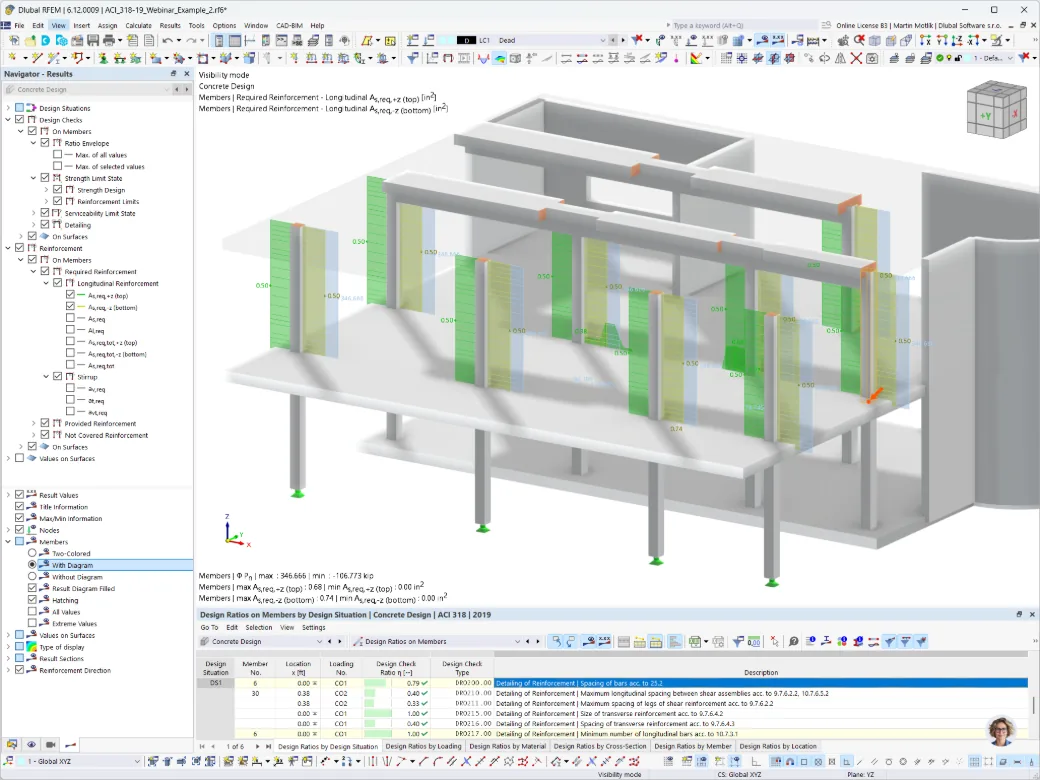
- Design ratios and required reinforcement shown in colour on the model
- On surfaces, design strips place the reinforcement and work out the anchorage length by themselves
- Where design is not possible, the program sets out the reason in detail
- For members, fatigue checks to EN 1992-1-1 and seismic checks to EC 8 as well
- Result tables and graphics that go straight into the RFEM printout report


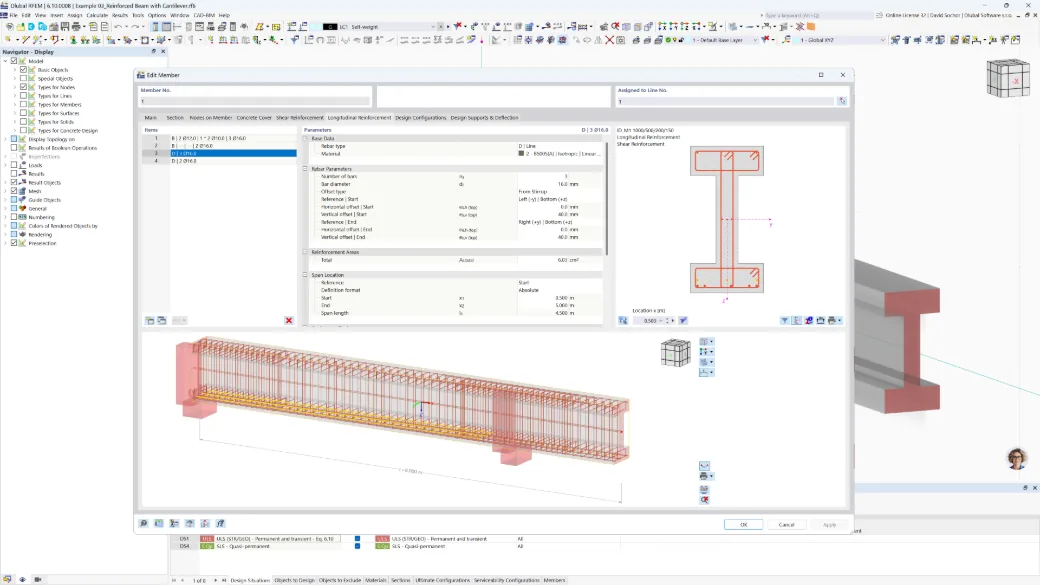
Reinforcement defined where you model
Longitudinal, shear and torsional reinforcement is set for each member separately, with ready-made templates that speed up input.
- The bar layout is shown in section and in 3D, with the coordinates of each bar relative to the centroid
- Similar bars get consecutive position numbers
- RSECTION sections with cover and reinforcement are taken into RFEM 6 and receive every design check
- Effective slab width of T-beams by segment, with stepped or linear transitions
- Slab reinforcement can count as flange reinforcement of the T-beam
Works with: RSECTION


Compression members with the nominal curvature method
Rectangular and circular sections are designed with the equivalent member method of the standard. To avoid nonlinear calculations, members can be turned into “model columns”.
- Planned and unintended eccentricity from second-order analysis calculated automatically
- Creep optionally included in the calculation
- Effective length factor entered by hand or taken from the Structure Stability add-on
- Governing locations along the column checked for bending and shear
- Required longitudinal and stirrup reinforcement, with every intermediate value


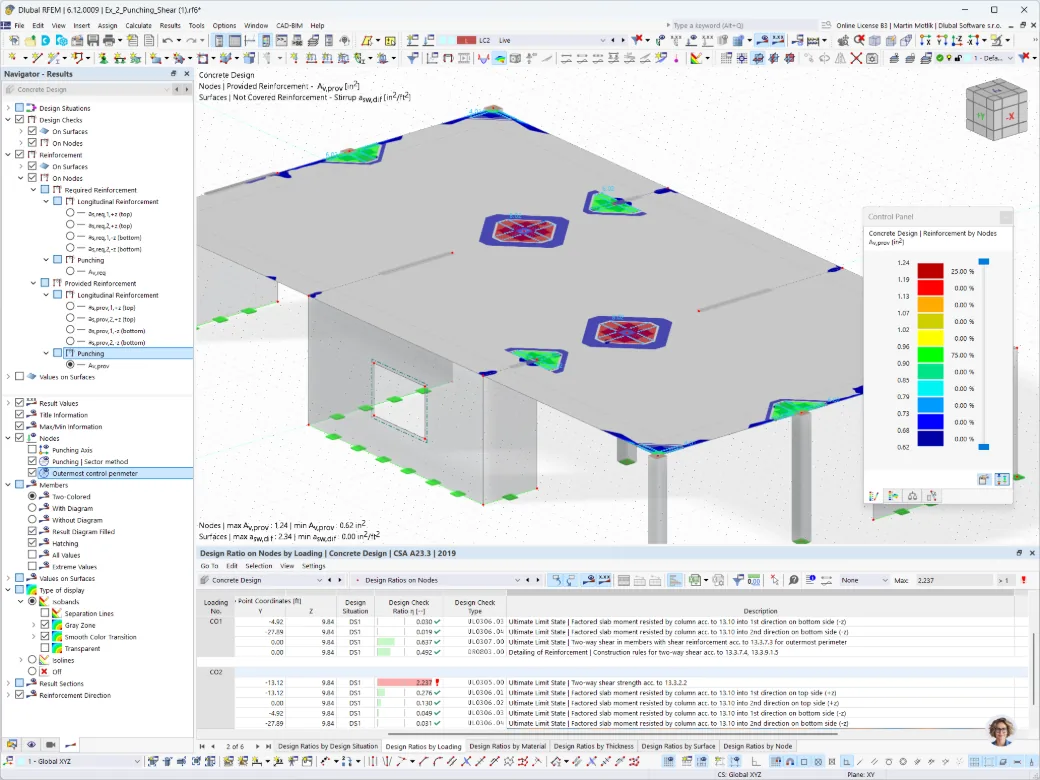
Punching shear of slabs on nodal, line and surface supports
The governing punching load is found automatically from the loading, foundation slabs included, with very little input from you.
- Columns of any shape, wall ends and wall corners
- Recognises whether a node is in the middle, at the edge or in a corner of the slab, and the openings in the model
- Control perimeter with curves or splines too, using unsmoothed shear stress as in the model
- Load increase factor β to EN 1992-1-1 or set by you
- Existing punching reinforcement of stirrups or headed studs, and required reinforcement where needed


Stresses, interaction diagrams and deflections in the cracked state
Beyond resistance, you see how the section works and how much the element deforms.
- Deformations in state II to EN 1992-1-1 and ACI 318-19, with tension stiffening between cracks
- Creep and shrinkage from the material properties, with a concrete age that is easy to change
- Stresses and strains of concrete and reinforcement in 3D or 2D
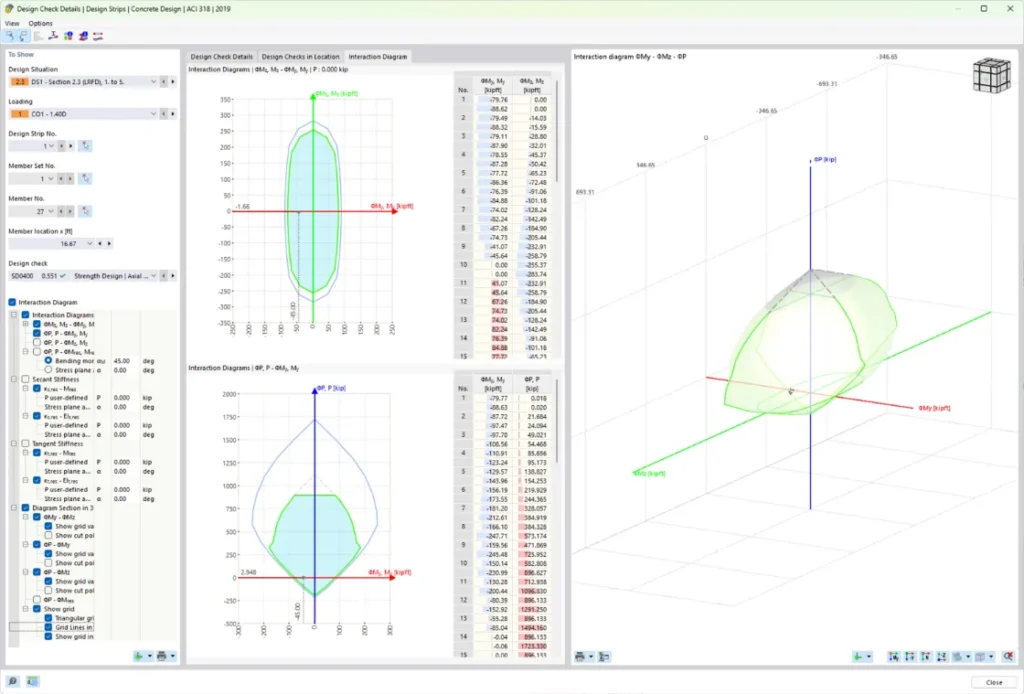
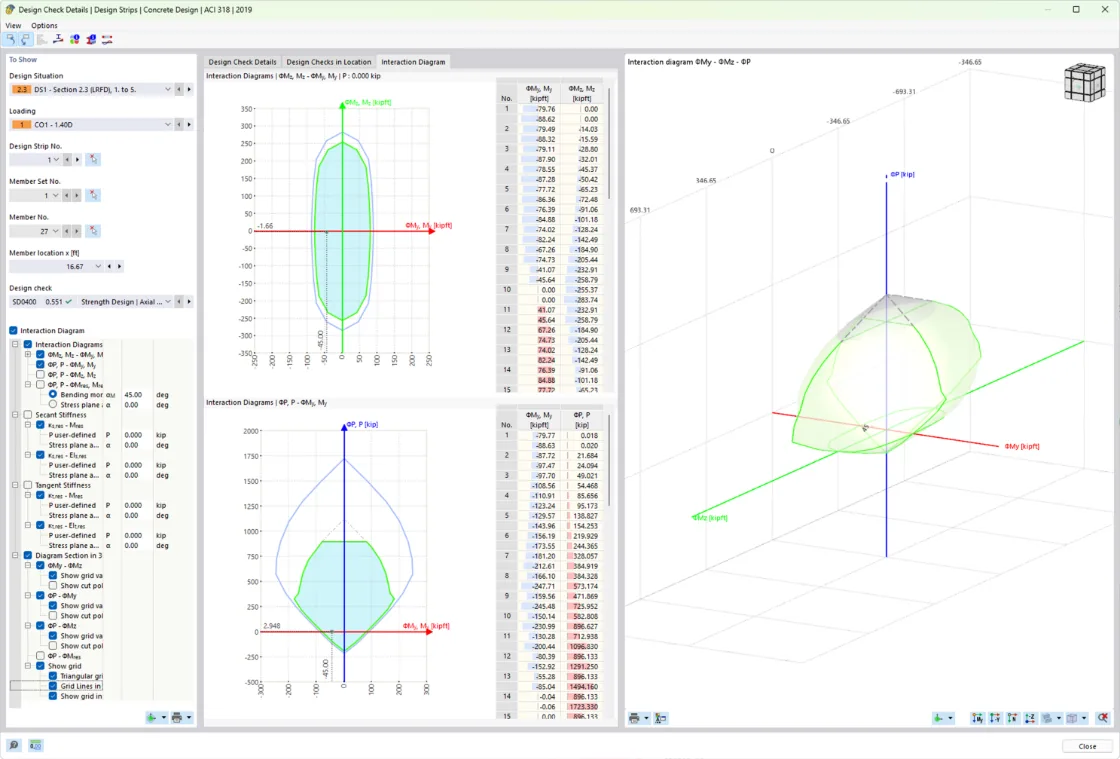
- 3D My-Mz-N interaction diagram for the ultimate limit state
- Members and surfaces together in the same deformation analysis


Eurocode 2 with national annexes and every check documented
Each check shows the input, intermediate and final results, and the info window traces the whole path with formulas and references to the standard.
- EN 1992-1-1:2004 + A1:2014 with many national annexes, among them Cyprus and the CEN version
- ACI 318-14, ACI 318-19, CSA A23.3-19, SP 63.13330:2018 and NTC 2018
- Fire design of slabs and walls with the simplified table method
- Steel-fibre-reinforced concrete to the DAfStb guideline, for design to EN 1992-1-1
Works with: Eurocode 2 ACI 318 CSA A23.3 SP 63.13330 NTC 2018


Concrete structures in RFEM 6 and RSTAB 9
Official Dlubal video on the analysis and design of concrete structures.

See it in action
The video or demo loads only when you press play.
What it does, stage by stage
With the Concrete Design add-on you carry out reinforced concrete design checks to international standards inside RFEM 6. You design members, member sets, surfaces and columns, and run punching shear checks and deformation analysis, at the ultimate and the serviceability limit state.
Internal forces are taken over automatically from RFEM, and the reinforcement is defined directly in the main program: longitudinal, shear and torsional reinforcement of members with ready-made templates, design strips on surfaces with automatic anchorage length, effective slab widths of T-beams by segment, and reinforced concrete sections from RSECTION.
For columns the add-on applies the equivalent member method of the standard, for example the nominal curvature method, or converts members into “model columns”. For punching shear it finds the position of each node by itself, takes the slab openings into account and works out the required punching and longitudinal reinforcement. Deformations are also calculated in the cracked state (state II), with creep and shrinkage.
It supports Eurocode 2 (EN 1992-1-1:2004 + A1:2014) with many national annexes, among them Cyprus (CYS EN 1992-1-1:2004/NA:2009) and the CEN version, as well as ACI 318-14, ACI 318-19, CSA A23.3-19, SP 63.13330:2018 and NTC 2018. Every check is documented with formulas and references to the standard, and the results go into the RFEM printout report.
Features
Features
- Elements
- members, member sets, surfaces and columns
- Limit states
- ultimate and serviceability, with the detailing rules of the standard
- Reinforcement
- longitudinal, shear and torsional per member, design strips on surfaces
- Columns
- nominal curvature method, rectangular and circular sections
- Punching shear
- at columns, wall ends and wall corners, with existing stirrups or headed studs
- Deformations
- state II to EN 1992-1-1 and ACI 318-19, with creep and shrinkage
- Special checks
- fire design of slabs and walls by tables, fibre-reinforced concrete to DAfStb
- Eurocode 2
- EN 1992-1-1:2004 + A1:2014 with national annexes (including Cyprus)
- Other standards
- ACI 318-14, ACI 318-19, CSA A23.3-19, SP 63.13330:2018, NTC 2018
All features
- Design of members, member sets, and surfaces (RFEM only) for the ultimate and serviceability limit states
- Automatic import of internal forces from RFEM/RSTAB
- User-defined limit values and parameters based on the integrated National Annexes (NA)
- Flexibility due to detailed setting options for basis and extent of calculations
- Graphical results in RFEM/RSTAB (e.g. design check ratios or required reinforcement), clear tables, and integration into the printout report
- Dimensioning of surfaces, beams, and compression members in one add-on, with free definition of the reinforcement in the main program
- Detailed documentation of each design check with input values, intermediate and final results, formulas used, and standard references
- In addition to the classic ultimate and serviceability checks, the structural requirements of the standard are taken into account
- Display of stresses and strains of a concrete cross-section and reinforcement as a 3D stress image or a 2D graphic
- 3D My-Mz-N interaction diagram for reinforced concrete cross-sections
- Deformation analysis of surfaces, also cracked (state II), per ACI 318-19 and EN 1992-1-1, with tension stiffening, creep, and shrinkage
- Interaction of members and surfaces in a deformation analysis
- Member reinforcement (longitudinal, shear, torsional) defined per member using templates, with the layout shown in the section and in 3D
- Fatigue design according to EN 1992-1-1 and seismic design according to EC 8 in the member design
- Design of any RSECTION cross-section, with concrete cover, shear, and longitudinal reinforcement defined in RSECTION
- Effective slab widths of T-beams defined by segment within a member, and surface reinforcement considered as flange reinforcement of the rib
- Existing vertical punching shear reinforcement (stirrups or headed studs) taken into account in the punching shear design
- Punching shear for slabs with nodal, line, and surface supports: columns, wall ends, and wall corners, with automatic node and opening recognition
- Columns designed with the equivalent member method (e.g. nominal curvature), "model columns", and the effective length factor β from Structure Stability
- Fiber-reinforced concrete per the DAfStb guideline (EN 1992-1-1) and fire design of slabs and walls by the simplified table method
System requirements
Operating system Windows
- Requires an RFEM 6 licence
Works well with, and alternatives
Works well with

Concrete Design for RFEM 6 next to alternatives
Open the full comparisonQuestions, licence and delivery
What do I need to use it?
An RFEM 6 licence. Concrete Design is an add-on for RFEM 6 and takes the internal forces of the same model automatically.
Which standards are supported?
Eurocode 2 (EN 1992-1-1:2004 + A1:2014) with many national annexes, and ACI 318-14, ACI 318-19, CSA A23.3-19, SP 63.13330:2018 and NTC 2018.
Is the Cyprus national annex included?
Yes, CYS EN 1992-1-1:2004/NA:2009 is in the list of Eurocode 2 national annexes, as is the CEN version.
How does it design columns?
With the equivalent member method of the standard, for example the nominal curvature method, for rectangular and circular sections. The effective length factor is entered by hand or taken from the Structure Stability add-on.
What does the punching shear check do?
It recognises whether a node lies in the middle, at the edge or in a corner of the slab, accounts for openings and checks slabs with nodal, line and surface supports. If the resistance without reinforcement is not enough, it gives the required punching and longitudinal reinforcement.
Does it calculate deflections of a cracked slab?
Yes. Deformation analysis also works in state II to EN 1992-1-1 or ACI 318-19, with tension stiffening between cracks and, if you wish, creep and shrinkage.
How do I receive the licence?
After payment we order the licence from the manufacturer and email you its details.
Do the prices include VAT?
Prices exclude VAT. With a valid VAT number from another EU country, VAT is not charged; in Belgium it is charged at 21%. For private customers, VAT is calculated at checkout.