
Craneway 8
by Dlubal Software, Structural analysis
Checking of crane runway girders to Eurocode 3, for steel structure designers
Craneway 8, stage by stage
From the girder and crane data to the Eurocode 3 checks, in the order a designer works.
Girder, cross-section and crane loads in separate windows
Enter geometry, material, cross-section, actions and imperfections in clear windows, and choose between a bridge crane and a suspension crane.
- Supports: hinged, movable, rigid or user-defined, lateral on the top or bottom flange, with optional warping restraint
- I-shaped sections from the usual series (IPE, HE-A, HE-B, W, UB and more), with a stiffener on the top flange and a rail, or unsymmetrical IU sections
- Up to three cranes at once, from a library or entered by hand, with up to 20 axles per crane
- Damage classes with editable dynamic factors, vertical and horizontal wheel loads, skewing and buffer forces
Works with: IPE HE-A HE-B

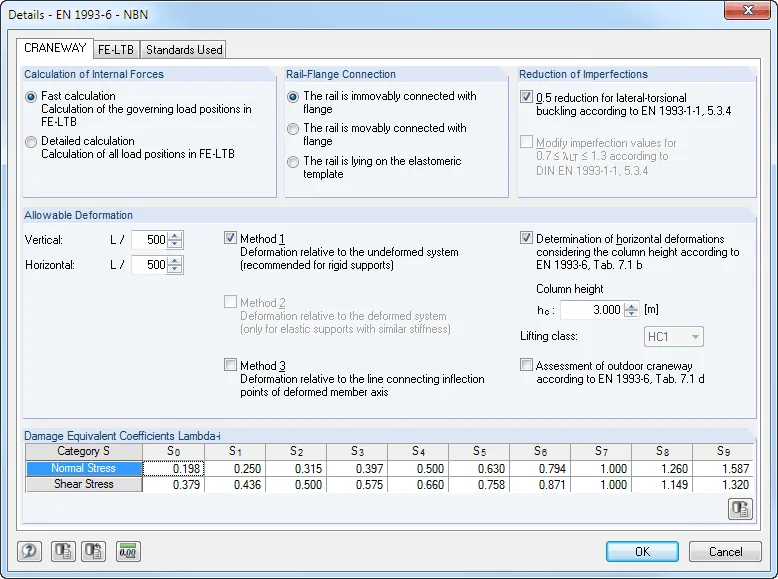
Crane loads at every position and second-order analysis
The program moves the crane along the girder in steps and checks all combinations for each position.
- You set the crane travel increment, as well as the finite element settings
- Checks for ultimate limit states, fatigue, deformations and support forces
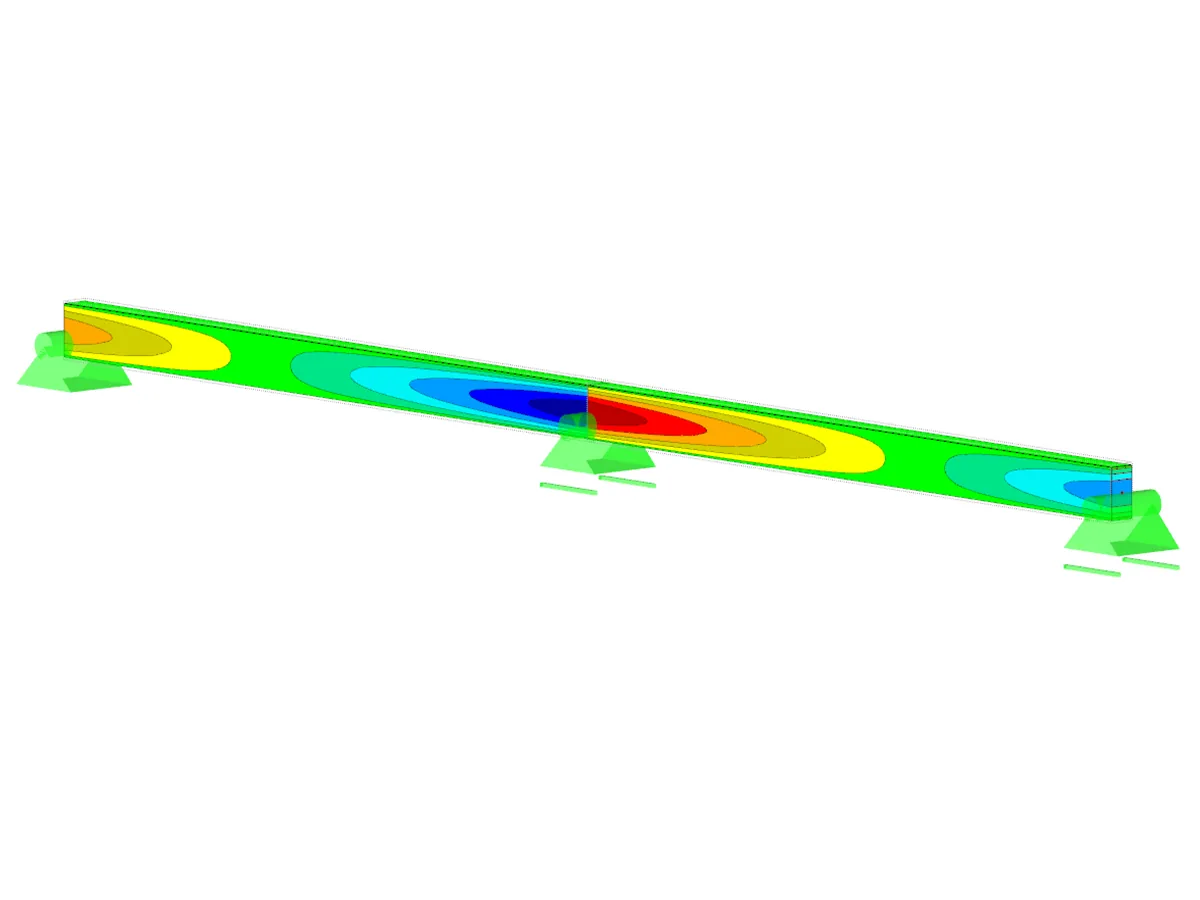
- Internal forces come from a model with imperfections, using second-order analysis for torsional buckling
- The imperfection follows the first natural mode, identical for all combinations or separate for each one


Stress, fatigue, buckling and deflection checks
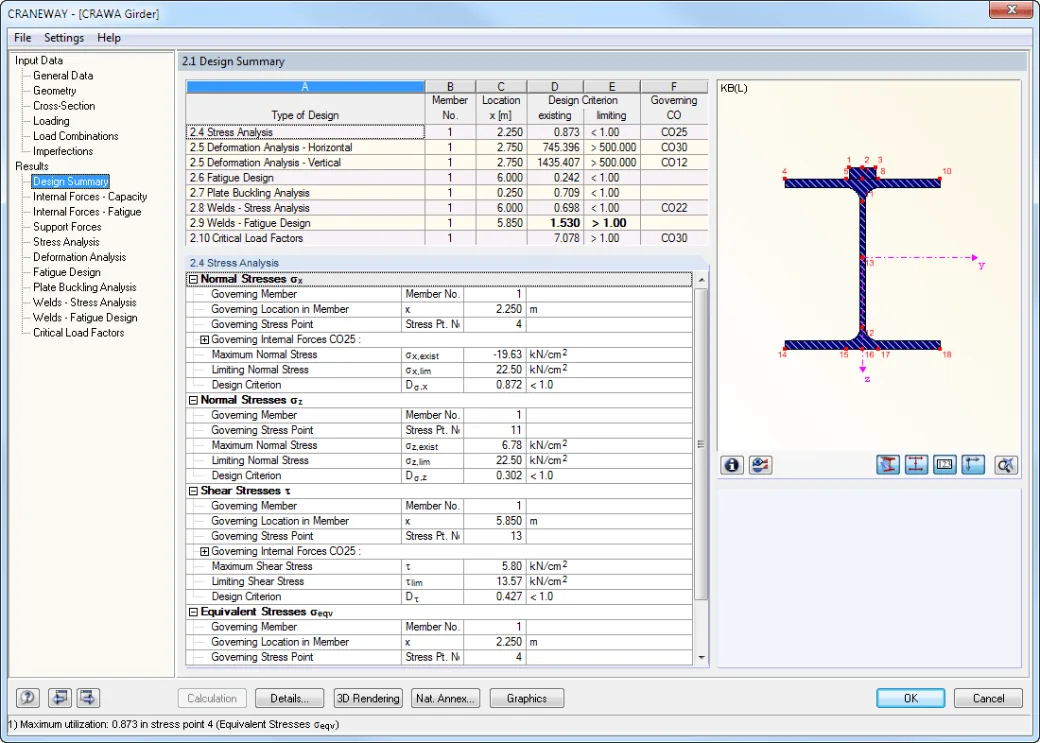
Results are arranged by topic, with the design values shown on the cross-section graphic and every intermediate value in the details.
- Stresses in the section and in the welds, compared with the limits for normal, shear and equivalent stress
- Fatigue for up to three cranes at once, using the nominal stress concept of EN 1993-1-9
- Web buckling at the wheel load introduction and lateral-torsional buckling check with a critical load factor
- Deformations separately for the vertical and horizontal directions, with allowable values you define, and all support forces

What it does, stage by stage
CRANEWAY is a standalone Dlubal program for the design of steel crane runway girders. It can examine an overhead travelling crane or a suspended crane, based on Eurocode 3 (EN 1993-6, EN 1993-1-9).
In the design of an industrial building or warehouse, the engineer defines the structure and the crane loads, and the program carries out the checks for stresses (including welds), fatigue, buckling at the wheel load introduction point, deformations and lateral-torsional buckling, as well as the calculation of support reactions.
Up to three cranes are supported simultaneously with up to 20 axles each, a crane library or manual input, and National Annexes of several countries, with the option of defining your own.
Features
Features
- Subject
- crane runway girders
- Code
- Eurocode 3 (EN 1993-6)
- Checks
- stresses, fatigue, buckling, deformations
- Cranes
- up to 3, up to 20 axles each
- National Annexes
- many countries + your own
- Trial
- 90 days
System requirements
Operating system Windows
- Windows application
Works well with, and alternatives
Works well with

Craneway 8 next to alternatives
Open the full comparisonQuestions, licence and delivery
Which codes does it apply?
Eurocode 3 (EN 1993-6, EN 1993-1-9) with National Annexes. The manufacturer also lists DIN 4132 and DIN 18800-3.
Do I need RFEM or RSTAB?
No. It is a standalone program; Dlubal presents it as separate from RFEM and RSTAB.
Is there a trial?
Yes, Dlubal offers a free full 90-day version.
What kind of licence is it?
The manufacturer lists purchase, rental for 1, 3 or 6 months, and a 12-month subscription.
How do I receive the licence?
After payment we order the licence from the manufacturer and email you its details.
Do the prices include VAT?
Prices exclude VAT. With a valid VAT number from another EU country, VAT is not charged; in Belgium it is charged at 21%. For private customers, VAT is calculated at checkout.