
Masonry Design for RFEM 6
by Dlubal, Structural analysis
Finite element design and checking of masonry in RFEM 6
Dlubal programs and add-ons
RFEM 6 is the main program; add-ons are bought separately, whenever you need them. Click an add-on to see what it does and its price.
Main programs 4
-
RFEM 6
Finite element structural analysis for civil engineers
from 3.325 €
- Method: finite elements
- Elements: bars, plates, shells, solids
- Design: with add-ons (concrete, steel, timber, glass)
-
RSTAB 9
Structural analysis of frames and trusses for civil engineers
from 1.842,50 € per year
- Structures: bars, frames, trusses
- Analysis: linear and non-linear
- Design: with add-ons
-
RSECTION 1
Section properties and stress checks for thin-walled and solid sections
1.855 €
- Purpose: cross-section properties, stresses
- Cross-sections: thin-walled and solid
- Import: DXF, CAD tools, script
-
RWIND 3
Digital wind tunnel CFD for wind loads on buildings and structures
from 2.880 €
- Method: CFD, digital wind tunnel (OpenFOAM®)
- Editions: Basic, Pro
- Basic: steady flow, RAS k-ε, k-ω turbulence
Design 10
-
Steel Design
Strength, stability and serviceability checks of steel members in RFEM 6
2.065 €
- Limit states: ultimate and serviceability
- Standards: Eurocode 3, AISC 360, CSA S16 and others
- Sections: rolled, hollow, parametric, composite, from RSECTION
-
Stress-Strain Analysis
Stress analysis of members, surfaces and solids against limit stresses
945 €
- Objects: members, member sets, surfaces, solids
- Stresses: normal, shear, principal, membrane, equivalent
- Equivalent stress: von Mises, Tresca, Rankine, Bach
-
Concrete Design
Reinforced concrete in RFEM 6: members, surfaces, columns and punching shear
2.065 €
- Elements: members, member sets, surfaces and columns
- Limit states: ultimate and serviceability, with the detailing rules of the standard
- Reinforcement: longitudinal, shear and torsional per member, design strips on surfaces
-
Concrete Foundations
Geotechnical checks and design of concrete foundations inside RFEM 6
875 €
- Foundation types: reinforced and unreinforced plates, bucket and block foundations
- Geotechnical checks: bearing capacity, sliding, uplift, overturning
- Standards: Eurocode 7, Eurocode 2, ACI 318, IBC
-
Tendons
Realistic modelling of prestressed and post-tensioned tendons in RFEM 6
1.316 €
- Geometry: free 3D definition of tendons
- Internal forces: statically determinate and indeterminate from prestressing
- Assignment: automatic to members, member sets and ribs
-
Aluminum Design
Strength, stability and serviceability checks of aluminium members in RFEM 6
1.365 €
- Limit states: ultimate and serviceability
- Standards: EN 1999-1-1, ADM 2020 and others
- Section resistance: tension, compression, bending, shear, torsion, combinations
-
Glass Design
Design of single and laminated glass panes in RFEM 6
1.295 €
- Panes: single and laminated
- Standards: DIN 18008, ASTM E1300 or no standard
- Geometry: flat and curved panes
-
Masonry Design
Finite element design and checking of masonry in RFEM 6
1.295 €
- Method: finite elements, macro-modelling
- Material model: elastic-plastic after Lourenço (Rankine and Hill)
- Checks: walls in compression and shear
-
Timber Design
Strength, stability, serviceability and fire checks of timber structures in RFEM 6
1.505 €
- Limit states: ultimate, serviceability and fire
- Standards: EN 1995, NDS, CSA O86, SIA 265 and others
- Elements: members and surfaces of timber and wood-based materials
-
Multilayer Surfaces (such as Laminate, CLT)
Multilayer surfaces such as CLT and laminate, with your own layer build-up
1.155 €
- Program: RFEM 6 (add-on)
- Applications: CLT, laminate, textile-reinforced concrete, glass panes, fibre-reinforced plastics
- Layers: free build-up, graphic display of orientation
Connections 2
-
Steel Joints
Finite element analysis and design of steel connections inside RFEM 6
1.855 €
- Method: CBFEM, finite element model in the background
- Standards: EN 1993-1-8, AISC 360-22, AISC 360-16, CSA S16-24
- Components: plates, bolts, welds, base plates with anchors
-
Components
Design of construction products such as joist hangers and tension rods inside RFEM 6
1.015 €
- Products: studs, joist hangers, cables, tension rods, etc.
- Assignment: to members and member ends
- Forces: transferred automatically from the calculation
Dynamic analysis 4
-
Modal Analysis
Natural frequencies, periods and mode shapes of your structure in RFEM 6
945 €
- Program: RFEM 6 (add-on)
- Results: eigenvalue, angular frequency, natural frequency, period
- Mode shapes: graphical display and animation in the model
-
Response Spectrum Analysis
Seismic analysis with response spectra and equivalent static loads in RFEM 6
1.085 €
- Program: RFEM 6 (add-on)
- Methods: response spectrum, equivalent static loads
- Spectra: EN 1998-1 (25+ National Annexes), ASCE 7, NBC and others
-
Time History Analysis
Time-domain dynamic analysis: earthquakes, vibrations, blast, moving loads
1.015 €
- Program: RFEM 6 (add-on)
- Analysis types: accelerogram, time diagram
- Solvers: linear modal, linear and nonlinear implicit Newmark
-
Pushover Analysis
Pushover analysis: capacity curve and target displacement to Eurocode 8
1.015 €
- Program: RFEM 6 (add-on)
- Plastic hinges: steel to FEMA 356 and EN 1998-3
- Nonlinear material: masonry, bilinear steel, your own curves
Additional analyses 7
-
Nonlinear Material Behavior
Nonlinear material models in RFEM 6: plasticity, damage and cracking
1.155 €
- Program: RFEM 6 (add-on)
- Calculation: iterative, with stiffness adjustment
- Isotropic models: plastic, nonlinear elastic, damage
-
Structure Stability
Critical load factors and buckling modes of the whole structure in RFEM 6
1.015 €
- Methods: eigenvalue and incremental (nonlinear)
- Elements: members, shells, solids
- Eigenvalue solvers: Lanczos, roots of characteristic polynomial, subspace iteration
-
Construction Stages Analysis (CSA)
Stage-by-stage analysis of the construction process for members, surfaces and solids
1.225 €
- Elements: members, surfaces, solids
- Stages: defined and displayed in the RFEM model
- Changes per stage: add, remove, modify, reactivate
-
Torsional Warping (7 DOF)
Cross-section warping as a 7th degree of freedom in RFEM 6 member analysis
1.225 €
- Degrees of freedom: 7 (ux, uy, uz, φx, φy, φz, ω)
- Internal forces: 8, including Mt,pri, Mt,sec and bimoment Mω
- Analyses: linear static, second-order, large deformation
-
Time-Dependent Analysis (TDA)
Creep, shrinkage and ageing of concrete over time in RFEM 6
805 €
- Program: RFEM 6 (add-on)
- Effects: creep, shrinkage, ageing
- Elements: members and surfaces
-
Form-Finding
Equilibrium shapes of membranes, cable structures and air-supported structures in RFEM 6
1.610 €
- Program: RFEM 6 (add-on)
- Elements: members with axial force, membrane surfaces in tension
- Method: Updated Reference Strategy (URS)
-
Geotechnical Analysis
Soil from boring logs, piles and soil-structure interaction inside RFEM 6
1.155 €
- Program: RFEM 6 (add-on)
- Soil data: soil samples from boring logs
- Soil massif: automatic, with layer boundaries and groundwater
Special solutions 3
-
Model Optimization & Costs
Optimisation of parametric models in RFEM 6 with particle swarm optimisation (AI)
1.155 €
- Program: RFEM 6 (add-on)
- Methods: particle swarm optimization (PSO), batch processing
- Criteria: minimum weight or minimum deformation
-
Building Model
Stories, diaphragms and stability of multi-storey buildings in RFEM 6
1.365 €
- Program: RFEM 6 (add-on)
- Stories: building defined by stories, with settings per story
- Diaphragms: rigid, semi-rigid, flexible or none
-
WebService & API
Programmable interface for RFEM 6, RSTAB 9 and RSECTION 1, with Python and C#
1.090 € per year
- Programs: RFEM 6, RSTAB 9, RSECTION 1
- Technology: WebService with SOAP, request and response communication
- Languages: high-level libraries for Python and C#
Services 1
-
Service Contract
Support and updates contract for RFEM 6, RSTAB 9, RSECTION 1 and RWIND 3
on request
- Levels: Basic, Pro
- Term: 1 year
- Programs: RFEM 6, RSTAB 9, RSECTION 1, RWIND 3
First-licence prices for Greece and Cyprus, excluding VAT. The add-ons work inside RFEM 6.
Masonry with finite elements, inside RFEM 6
Choose a topic and see how Masonry Design models, calculates and checks masonry.
A nonlinear model from a research project
The material model was developed in the DDMaS project and treats units and mortar as one material.
- Lourenço approach with a composite yield surface to Rankine and Hill
- Parameters calibrated to the design curves of the standard
- Material values to Eurocode 6 (ÖN EN 1996) from a database of units and mortars
- Calculation without a standard is possible too


The whole building or a single wall
Walls are modelled directly in RFEM, on their own or within the whole building.
- Real distribution of internal forces from the analysis of the whole system
- Combined structures, e.g. masonry with reinforced concrete
- Works with other add-ons such as Construction Stages Analysis


The slab-wall connection with a special hinge
A special line hinge represents the connection between a reinforced concrete slab and a masonry wall.
- Automatic determination of the hinge stiffness
- Transferred forces limited according to the geometry
- Interaction diagrams applied automatically


Plastic redistribution and a stability check
The calculation follows the nonlinear plastic material law of the model.
- Loads redistributed where the resistance is exceeded, to restore equilibrium
- Stability check provided on successful completion of the calculation
- Option to run a pushover analysis


Masonry Design in RFEM 6
Official Dlubal video on the Masonry Design add-on.

See it in action
The video or demo loads only when you press play.
What it does, stage by stage
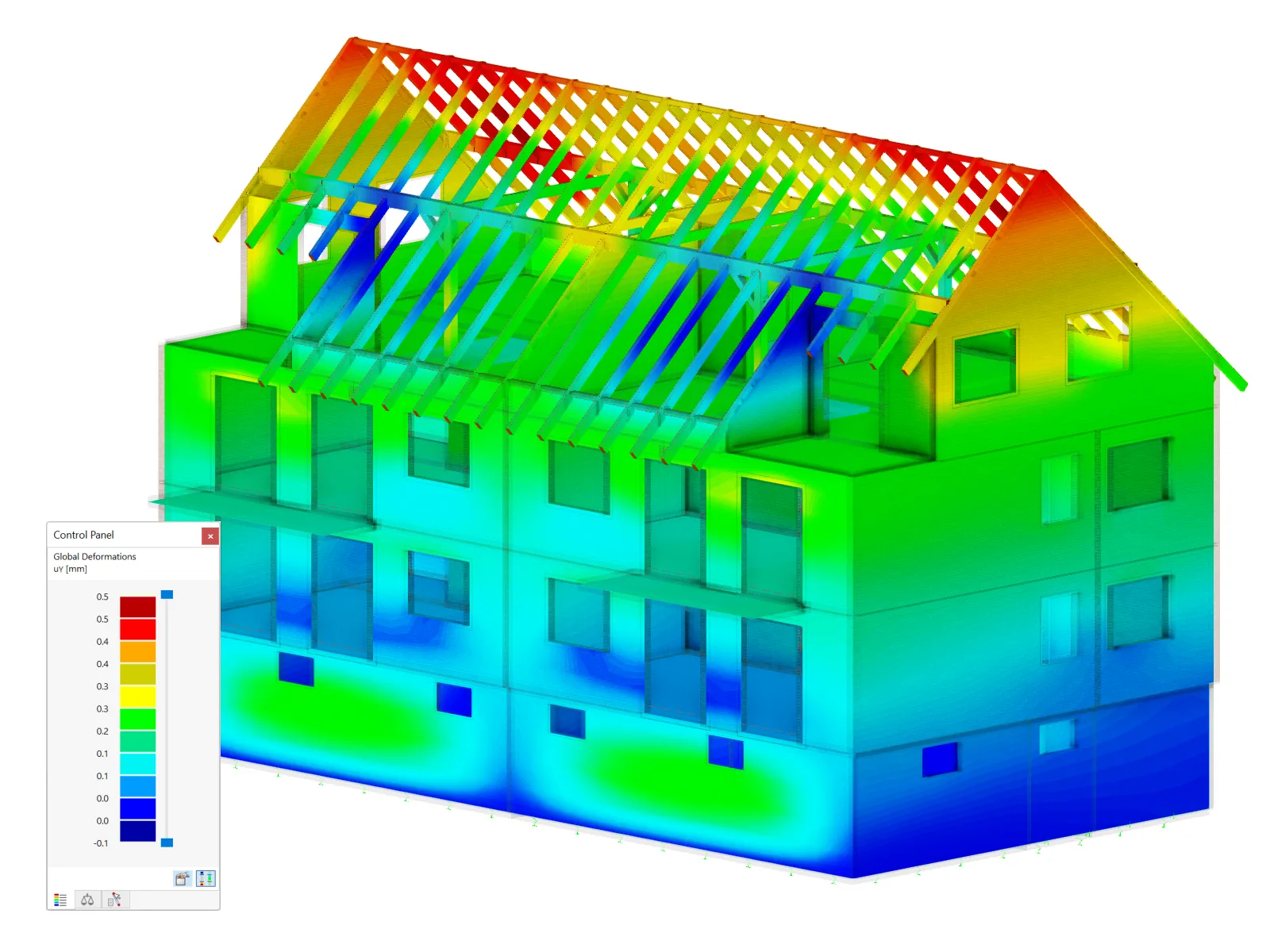
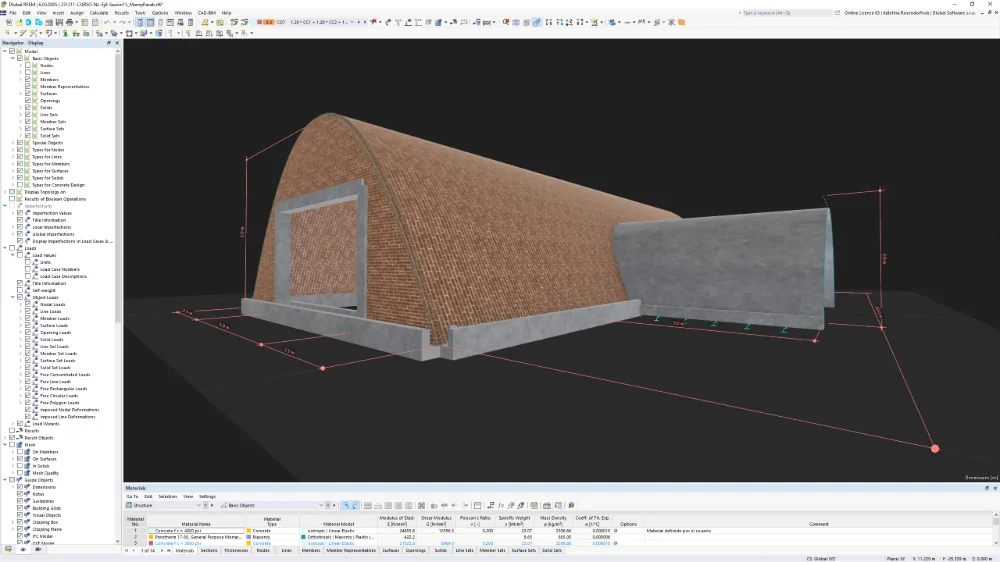
The Masonry Design add-on lets you design and check masonry in RFEM 6 using the finite element method. It was developed within the research project DDMaS (Digitizing the Design of Masonry Structures). The material model represents the nonlinear behaviour of the unit-mortar combination by macro-modelling.
The nonlinear model is based on Lourenço's approach, with a composite yield surface according to Rankine and Hill, so that the various failure mechanisms of masonry are described. Its parameters are calibrated to match the design curves of the standard. Material values are determined automatically to Eurocode 6 (ÖN EN 1996), from a database of unit-mortar combinations on the Austrian market that is continuously being expanded. You can also calculate masonry without reference to a standard.
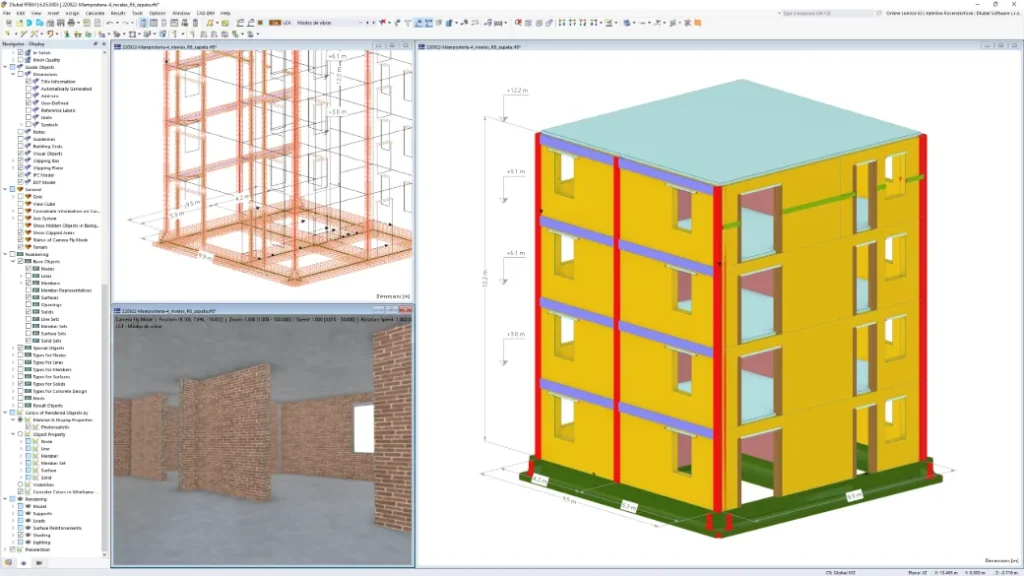
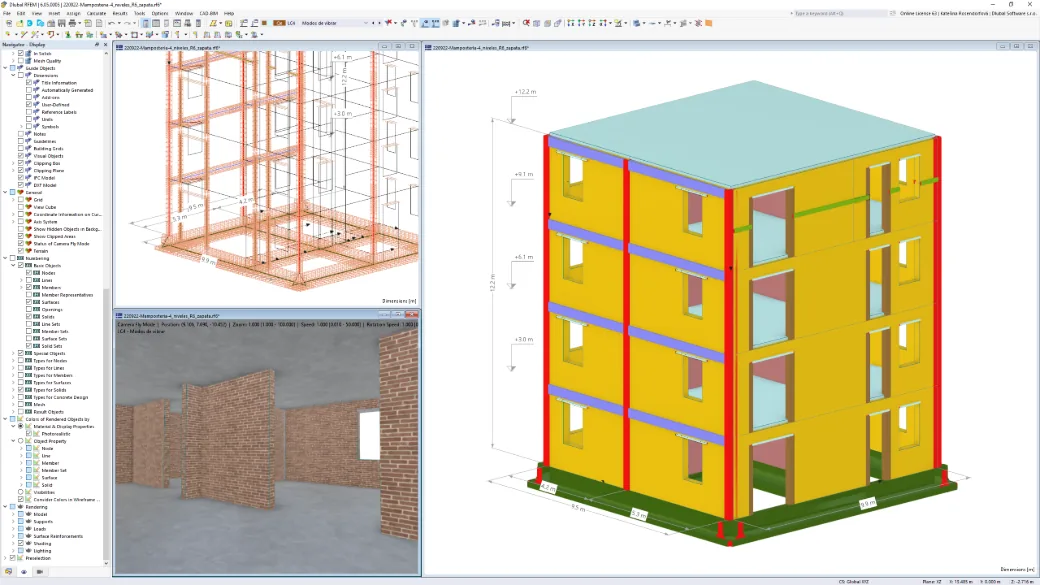
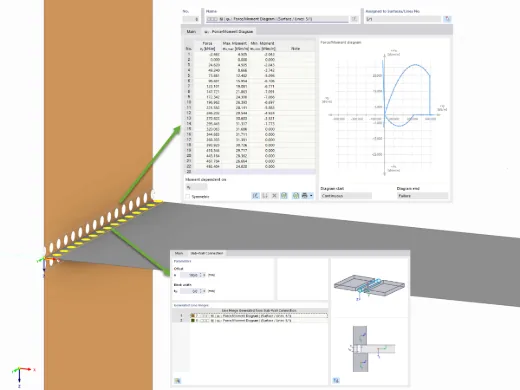
Walls are checked for compression and shear, either within the whole building or as a single model, so the distribution of internal forces comes from the entire system. You can combine masonry with reinforced concrete and with other RFEM add-ons such as Construction Stages Analysis. For the slab-wall connection there is a special line hinge that determines its stiffness automatically and limits the transferred forces according to the geometry.
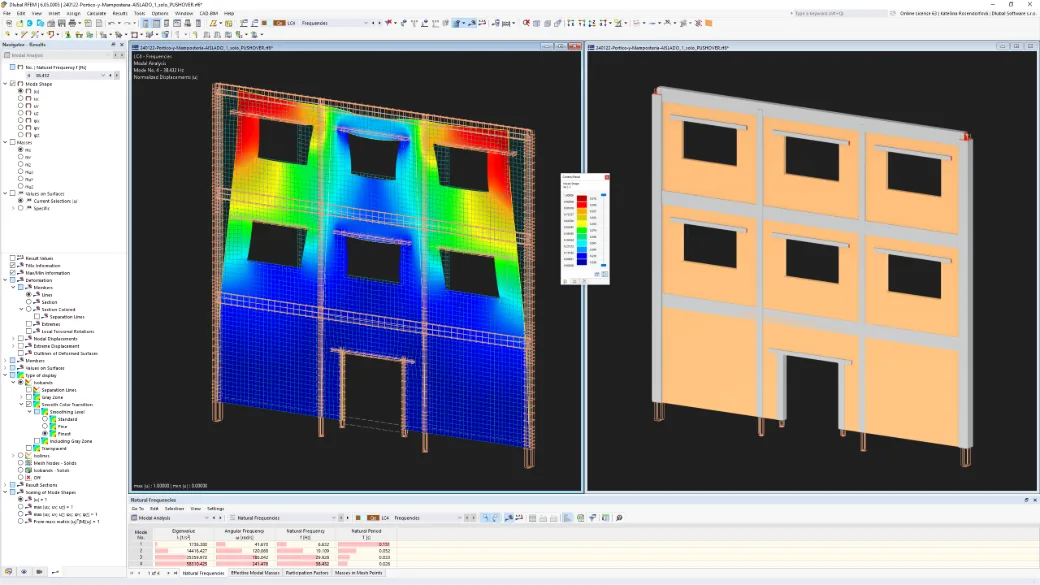
The calculation follows the nonlinear plastic material law: where the load exceeds the resistance, forces are redistributed to restore equilibrium, and successful completion of the calculation also provides the stability check. A pushover analysis is possible as well. As results you get the maximum stresses of the masonry surfaces, in detail at every mesh point.
Features
Features
- Method
- finite elements, macro-modelling
- Material model
- elastic-plastic after Lourenço (Rankine and Hill)
- Checks
- walls in compression and shear
- Standard
- material values to Eurocode 6 (ÖN EN 1996) or no standard
- Material database
- units and mortars of the Austrian market
- Slab-wall connection
- line hinge with automatic stiffness
- Combined structures
- masonry with reinforced concrete
- Analyses
- static, dynamic, pushover
- Results
- maximum stresses at every mesh point
All features
- Masonry design using the finite element method, with macro-modeling of the nonlinear behavior of the brick-mortar combination
- Nonlinear material model based on Lourenço's approach, with a composite yield surface according to Rankine and Hill for various failure mechanisms
- Stress determination using an elastic-plastic material model
- Design of masonry disc structures for compression and shear on the building model or single model
- Special line hinge for the slab-wall connection, with automatic determination of its stiffness from interaction diagrams
- Extensive material database for almost all stone-mortar combinations on the Austrian market, continuously being expanded
- Automatic determination of material values according to Eurocode 6 (ÖN EN 1996-X)
- Masonry design without standard reference, using the material model "Isotropic | Masonry | Plastic (Surfaces)"
- Option to create pushover analysis and structural dynamic calculations
- Easy modeling of masonry walls, with real internal force distribution from the analysis of the entire system
- Combined structures (for example, reinforced concrete/masonry) and combination with all common RFEM add-ons, such as Construction Stages Analysis
- Redistribution within the system when the load exceeds the resistance, followed by the stability analysis
- Maximum stresses of the masonry surfaces, displayed in detail at each FE mesh point
System requirements
Operating system Windows
- Requires an RFEM 6 licence
Works well with, and alternatives
Works well with

Masonry Design for RFEM 6 next to alternatives
Open the full comparisonQuestions, licence and delivery
What do I need to run it?
An RFEM 6 licence. Masonry Design is an RFEM 6 add-on and combines with the usual RFEM add-ons.
Which material model does it use?
A nonlinear model based on Lourenço's approach, with a composite yield surface according to Rankine and Hill, representing the various failure mechanisms of masonry.
Can I calculate masonry without a standard?
Yes. With the material model "Isotropic | Masonry | Plastic (Surfaces)" and "--" selected as the standard in the base data.
How is the slab-wall connection modelled?
With a special line hinge that limits the transferred forces according to the geometry. The interaction diagrams are applied automatically.
Does it calculate combined structures?
Yes, e.g. masonry with reinforced concrete, and it works with other add-ons such as Construction Stages Analysis.
Which materials are in the database?
Almost all unit-mortar combinations on the Austrian market. According to Dlubal, the database is continuously being expanded, for other countries as well.
How do I receive the licence?
After payment we order the licence from the manufacturer and email you its details.
Do the prices include VAT?
Prices exclude VAT. With a valid VAT number from another EU country, VAT is not charged; in Belgium it is charged at 21%. For private customers, VAT is calculated at checkout.