
SeismoSignal 3D
by Seismosoft, Structural analysis
Processing of 2D and 3D seismic records and motion parameters
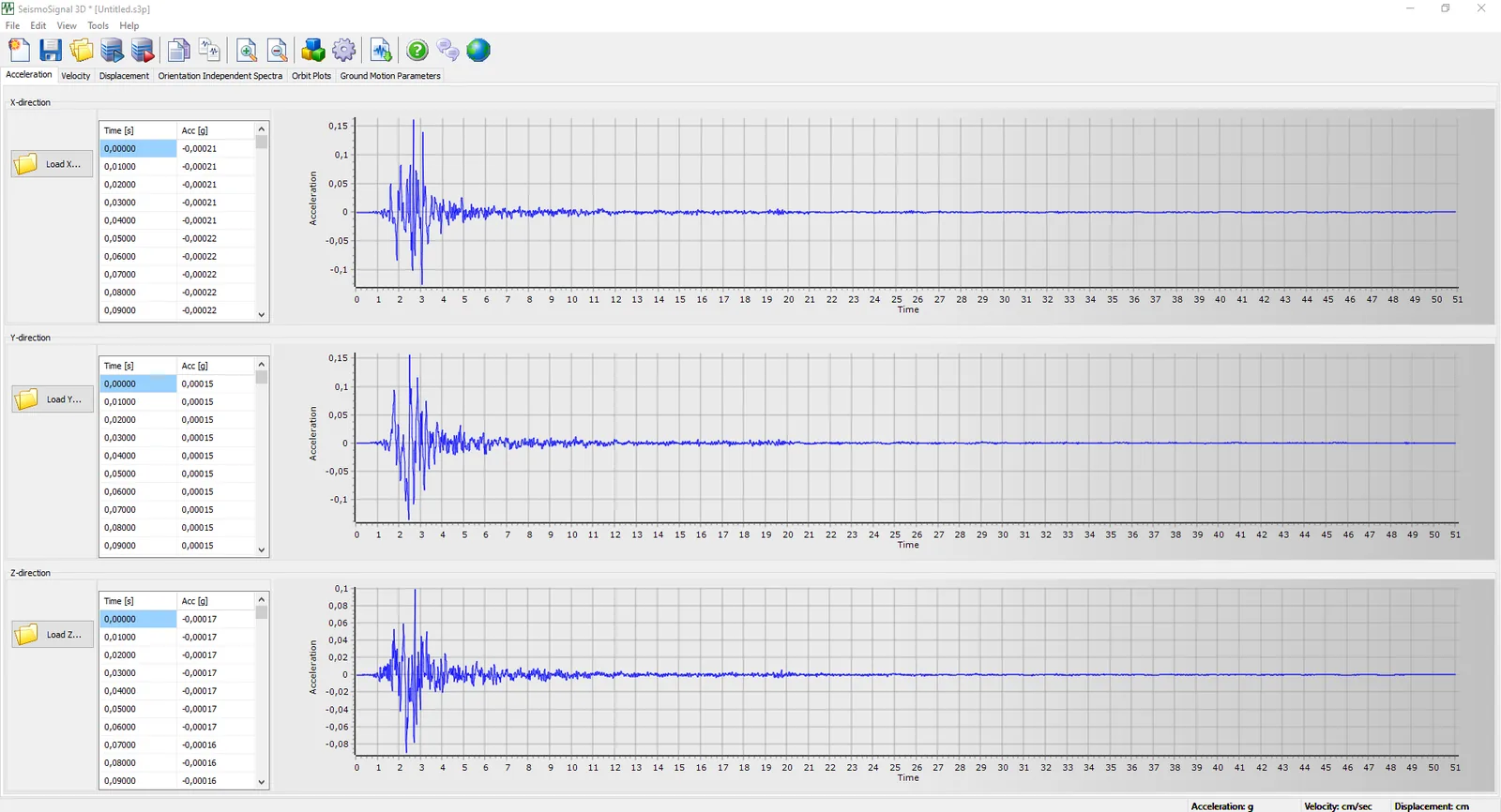
Three components of a record in one window
SeismoSignal 3D processes the horizontal and vertical components of a strong-motion record together and computes spectra that do not depend on how the instrument was oriented.
Loading and correcting the X, Y and Z components
Accelerograms for the three directions are shown one below the other, each with a table of values beside its plot.
- Zip files downloaded from the ESM, NGA-West 2 and NGA-East databases open directly, with no preparation.
- Text files with one or several values per line are also read, as are the SMC, PEER NGA and SHAKE formats.
- Baseline correction with a polynomial up to third degree.
- Butterworth, Chebyshev and Bessel filters, set up as lowpass, highpass, bandpass or bandstop.
Works with: ESM NGA-West 2 NGA-East SMC PEER NGA SHAKE (.eq)

Orientation-independent spectra and motion parameters
Spectra are calculated from the two horizontal components over a range of rotation angles, following Boore (2010).
- RotD100, RotD50, RotD00 and RotDxx for any percentile you need, with the damping of your choice.
- Spectra for each of the X, Y and Z directions are also available.
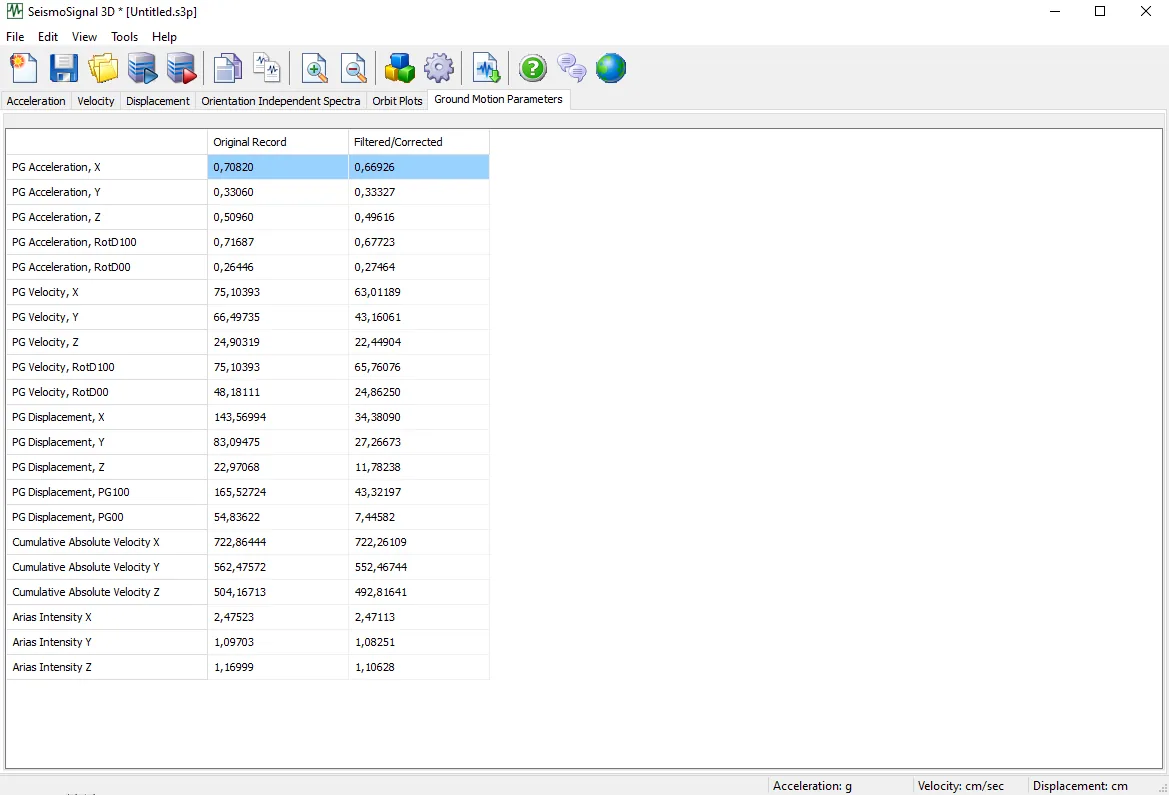
- PGA, PGV and PGD for every direction and for RotD100 and RotD00.
- Arias intensity and CAV for every direction, for both the original and the corrected record.
- Tables and charts copy into Excel or Word.
Works with: Excel Word

The ground’s path in plan and over time
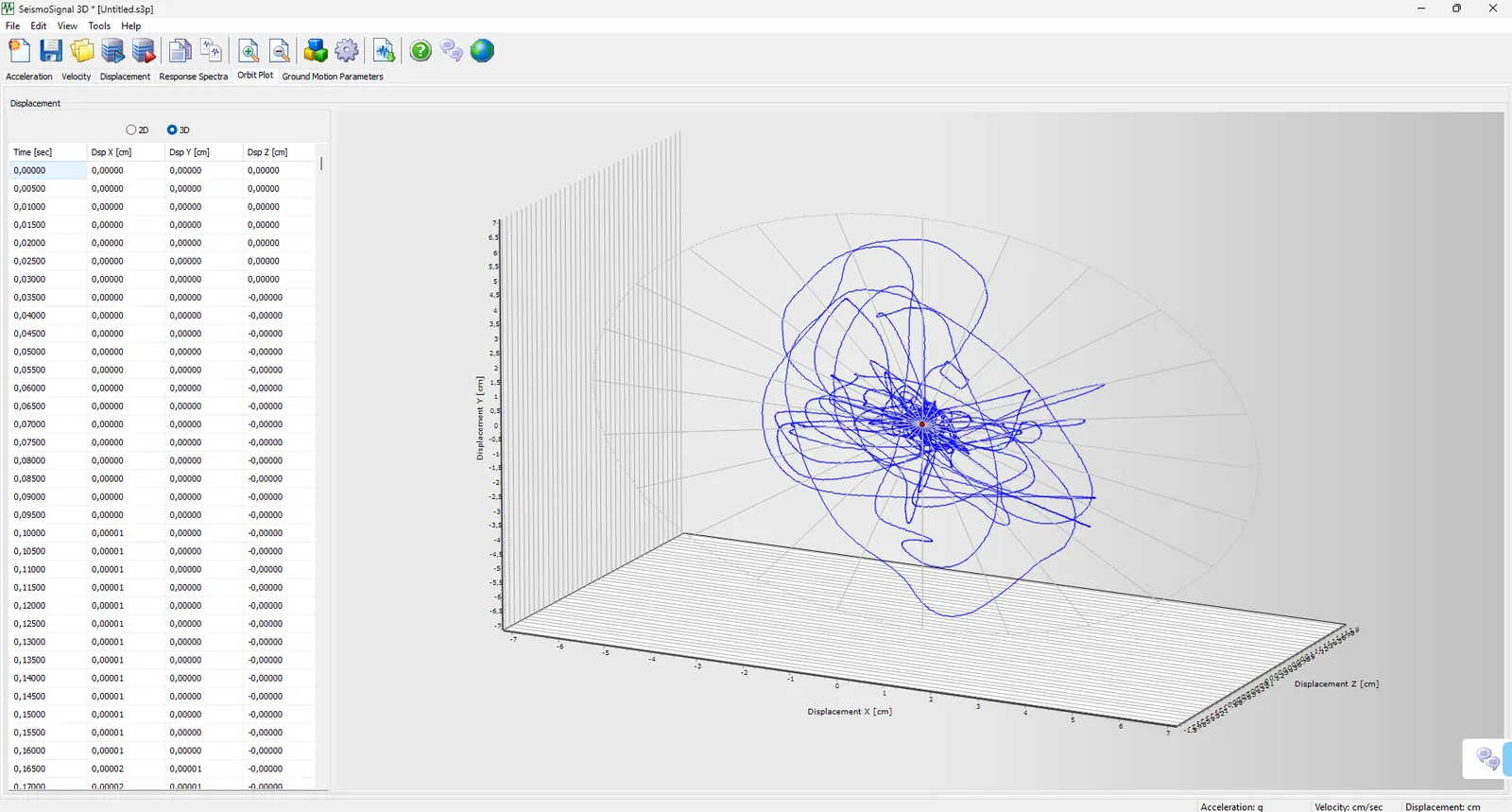
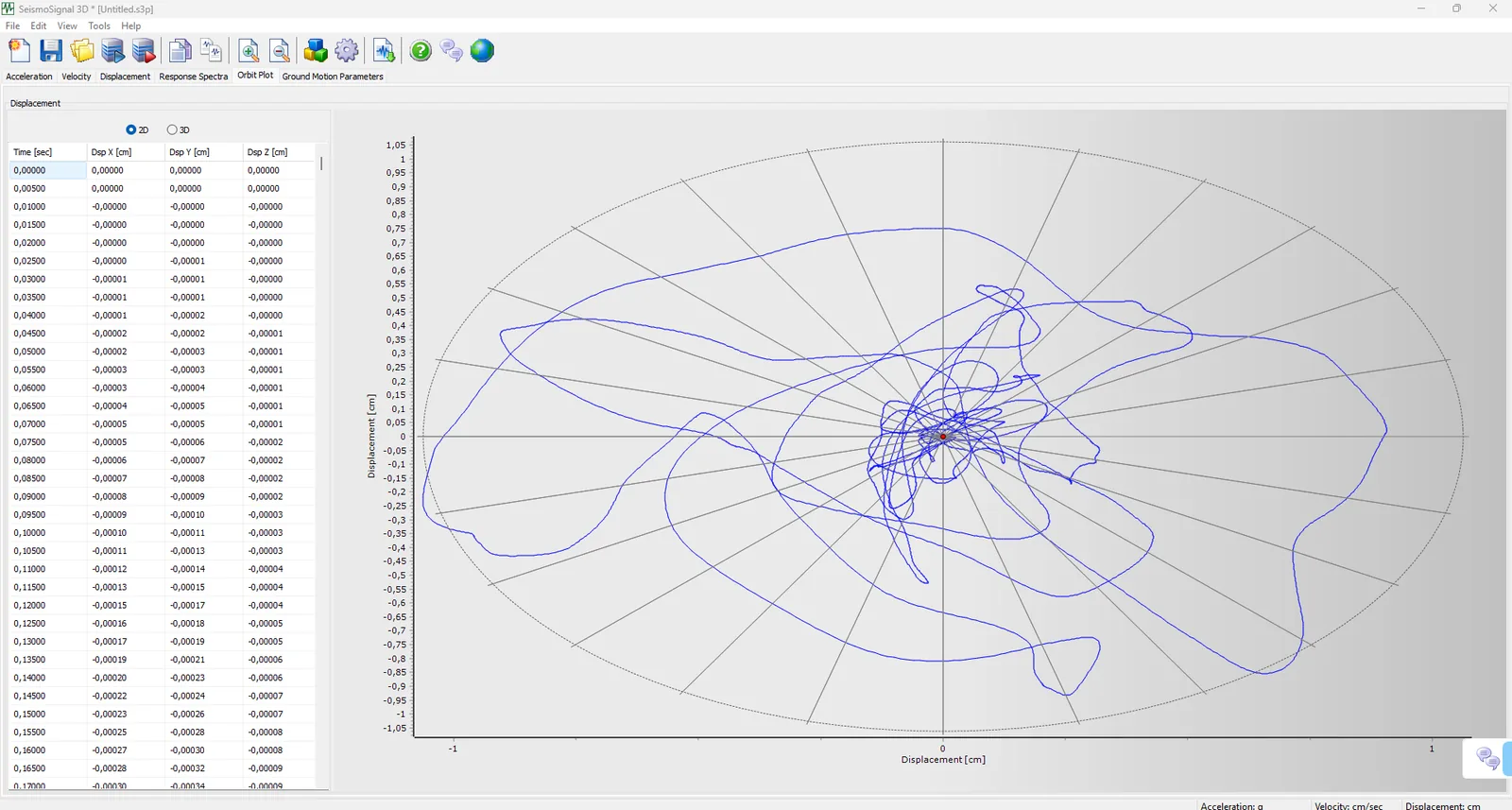
Integrating the horizontal accelerations gives the ground displacement, which is drawn as an orbit.
- A two-dimensional orbit of displacement in the X and Y directions.
- A three-dimensional orbit that adds time as a third axis.
- Next to the plot, a table with the displacements at each time step.
- It shows clearly which way the ground mainly moved and how the motion developed.


What it does, stage by stage
SeismoSignal 3D extends SeismoSignal to process strong ground motion records in two (X+Y) or three (X+Y+Z) directions simultaneously, in a visual environment.
In seismic studies it is used for baseline correction and filtering of the three components (N-S, E-W, vertical) together, and for calculating parameters such as PGA, PGV, PGD, Arias intensity and CAV, and spectra.
It also calculates RotD100 and RotD50 spectra, independent of the sensor angle, which modern codes such as ASCE 7-22 and ASCE 41-23 require. The results are exported to standard tables and diagrams for the technical report.
Features
Features
- Purpose
- processing of seismic records
- Directions
- 2 (X+Y) or 3 (X+Y+Z)
- Corrections
- baseline, filters
- Parameters
- PGA, PGV, PGD, Arias, CAV
- Spectra
- RotD100, RotD50
- Licences
- computer, USB dongle, network
System requirements
Operating system Windows
- Windows application (integration with the Windows environment, e.g. copying results to Excel and Word)
Works well with, and alternatives
Works well with

SeismoSignal 3D next to alternatives
Open the full comparisonQuestions, licence and delivery
What does it add compared with SeismoSignal?
Simultaneous processing of two or three components and RotD spectra, independent of the sensor orientation.
Which codes are mentioned?
The manufacturer states RotD spectra as a requirement of ASCE 7-22 and ASCE 41-23.
What licence is there?
The manufacturer offers a licence tied to one computer, a USB dongle or a network licence.
Is there a trial and an academic licence?
Yes, the manufacturer states a one-month trial version and academic licences for students and researchers.
How do I receive the licence?
After payment we order the licence from the manufacturer and email you its details.
Do the prices include VAT?
Prices exclude VAT. With a valid VAT number from another EU country, VAT is not charged; in Belgium it is charged at 21%. For private customers, VAT is calculated at checkout.