
Structure Stability for RSTAB 9
by Dlubal, Structural analysis
Critical load factors and buckling modes of member structures in RSTAB 9
RSTAB 9 and its add-ons
RSTAB 9 is the main program for beams, frames and trusses; the add-ons are bought separately, whenever you need them. Click an add-on to see what it does and its price.
Main programs 1
-
RSTAB 9
Structural analysis of frames and trusses for civil engineers
from 2.345 € per year
- Structures: bars, frames, trusses
- Analysis: linear and non-linear
- Design: with add-ons
Design 6
-
Steel Design
Strength, stability and serviceability checks of steel members in RSTAB 9
from 2.065 € per year
- Limit states: ultimate and serviceability
- Standards: Eurocode 3 and other international standards, e.g. AISC 360
- Sections: rolled, hollow, parametric, built-up, from RSECTION
-
Stress-Strain Analysis
Stress analysis of RSTAB 9 members against limit stresses
from 945 € per year
- Objects: members and member sets
- Stresses: normal, shear, equivalent
- Limit stress: from the material or user-defined, also by sign
-
Concrete Design
Reinforced concrete in RSTAB 9: beams, columns and member sets
from 2.065 € per year
- Elements: members and member sets: beams and columns
- Limit states: ultimate and serviceability, with detailing rules
- Reinforcement: longitudinal, transverse and torsional per member
-
Concrete Foundations
Geotechnical checks and design of concrete foundations inside RSTAB 9
from 875 € per year
- Foundation types: reinforced and unreinforced plates, bucket, block, stepped
- Bucket sides: smooth or rough
- Geotechnical checks: bearing capacity, sliding, uplift, overturning
-
Aluminum Design
Strength, stability and serviceability checks of aluminium members in RSTAB 9
from 1.365 € per year
- Limit states: ultimate and serviceability
- Standards: various, including ADM
- Sections: rolled, hollow, parametric, built-up, RSECTION
-
Timber Design
Strength, stability, serviceability and fire checks of timber members in RSTAB 9
from 1.505 € per year
- Limit states: ultimate, serviceability and fire
- Standards: EN 1995, AS 1720, GB 50005 and others
- Sections: rectangular, circular, T, built-up, parametric
Dynamic analysis 4
-
Modal Analysis
Natural frequencies, periods and mode shapes of frame structures in RSTAB 9
from 945 € per year
- Program: RSTAB 9 (add-on)
- Solvers: Subspace Iteration, shifted inverse power method
- Eigenvalues: up to 9,999
-
Response Spectrum Analysis
Seismic analysis with response spectra and equivalent static loads in RSTAB 9
from 1.085 € per year
- Program: RSTAB 9 (add-on)
- Method: multi-modal response spectrum analysis
- Codes: EN 1998-1 (25+ National Annexes, incl. ELOT), ASCE 7, NBC, SIA 261 and others
-
Time History Analysis
Dynamic analysis in the time domain for time diagrams and earthquakes in RSTAB 9
from 1.015 € per year
- Program: RSTAB 9 (add-on)
- Excitation: force-time diagrams, support accelerograms
- Linear solvers: linear modal, linear implicit Newmark
-
Pushover Analysis
Pushover analysis in RSTAB 9: capacity curve and target displacement to EC 8
from 1.015 € per year
- Program: RSTAB 9 (add-on)
- Plastic hinges: steel to FEMA 356 and EN 1998-3
- Nonlinear material: masonry, bilinear steel, your own diagrams
Additional analyses 2
-
Structure Stability
Critical load factors and buckling modes of member structures in RSTAB 9
from 1.015 € per year
- Methods: eigenvalue and incremental (nonlinear)
- Eigenvalue solvers: Subspace Iteration, Shifted Inverse Iteration
- Activation: in a load case or combination, and via combination wizards
-
Torsional Warping (7 DOF)
Cross-section warping as a 7th degree of freedom in RSTAB 9 member analysis
from 1.225 € per year
- Degrees of freedom: 7 (ux, uy, uz, φx, φy, φz, ω)
- Internal forces: 8, including Mt,pri, Mt,sec and bimoment Mω
- Analyses: linear static, second-order, large deformation
Special solutions 1
-
Optimization & Costs / CO2
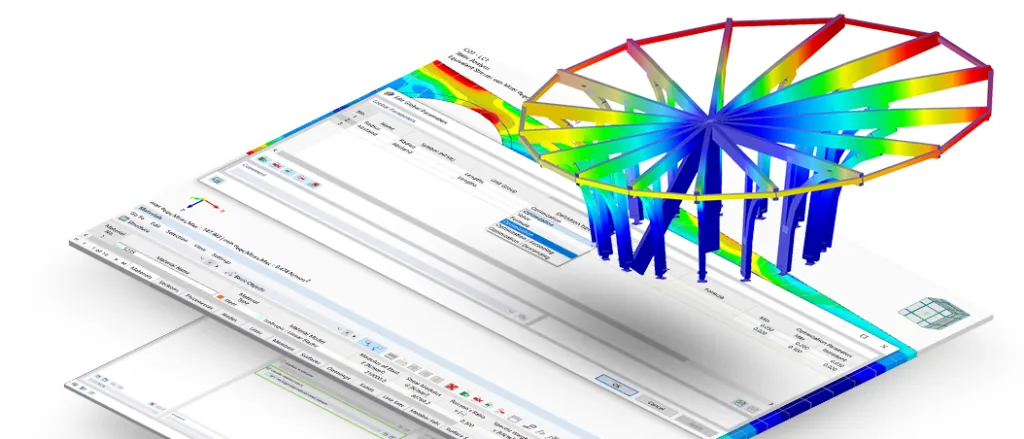
Optimisation of parametric member models in RSTAB 9 with particle swarm (AI)
from 1.155 € per year
- Program: RSTAB 9 (add-on)
- Methods: particle swarm optimization (PSO), batch processing
- Criteria: minimum weight or minimum deformation
First-licence prices for Greece and Cyprus, excluding VAT. The add-ons work inside RSTAB 9.
Stability of member structures, in numbers and pictures
See how the analysis is set up in RSTAB 9, which methods are available and which results you get.
Stability is switched on in the loading itself
In any load case or combination you activate the stability calculation and choose how it runs.
- Linear or nonlinear analysis, depending on the application
- Axial forces from initial prestress via a second load case
- Activation for several situations at once via the combination wizards
- Automatic division of members, so that local buckling also shows


Eigenvalues or a step-by-step load increase
Depending on the model, you choose an eigenvalue analysis or a nonlinear incremental analysis.
- Eigenvalue solvers in RSTAB: Subspace Iteration and Shifted Inverse Iteration
- Incremental method with failing members, supports, foundations and nonlinear materials
- Termination criteria for the load increase that you define
- Shift method for modes above a given load factor


Critical load factors, effective lengths and critical loads
You start from the critical load factors and move on to the figures for each member.
- Effective lengths and critical loads of members in filterable tables
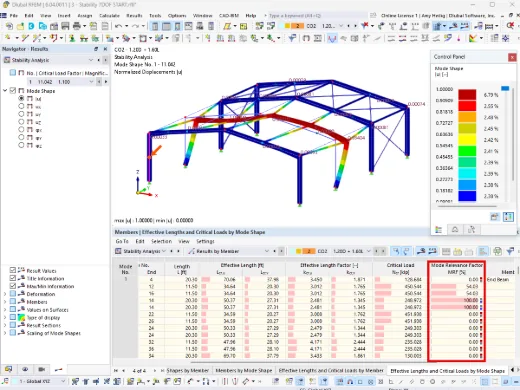
- Modal relevance factor: how much each member takes part in each mode shape
- Distinction between local and global stability modes


Member results for every buckling mode
For each mode shape you see what happens in the members, graphically and in tables.
- Local deformations, internal forces and strains per mode shape
- Normalised mode shapes by node and member
- The buckling mode as a basis for defining imperfections
- For unstable models, the mode shapes point to the cause

Linear stability analysis in RFEM 6 and RSTAB 9
Official Dlubal webinar on linear stability analysis.

See it in action
The video or demo loads only when you press play.
What it does, stage by stage
With the Structure Stability add-on you carry out a stability analysis in RSTAB 9 with minimum effort. The program determines the critical load factors and the corresponding stability modes of your member model.
The analysis uses the eigenvalue method or the incremental method. For eigenvalues, RSTAB offers the Subspace Iteration and Shifted Inverse Iteration methods. In the nonlinear incremental analysis the loads are raised step by step until instability, taking into account nonlinearities such as failing members, supports and foundations and nonlinear materials; a linear stability analysis can then be run on the last stable state to obtain the stability mode.
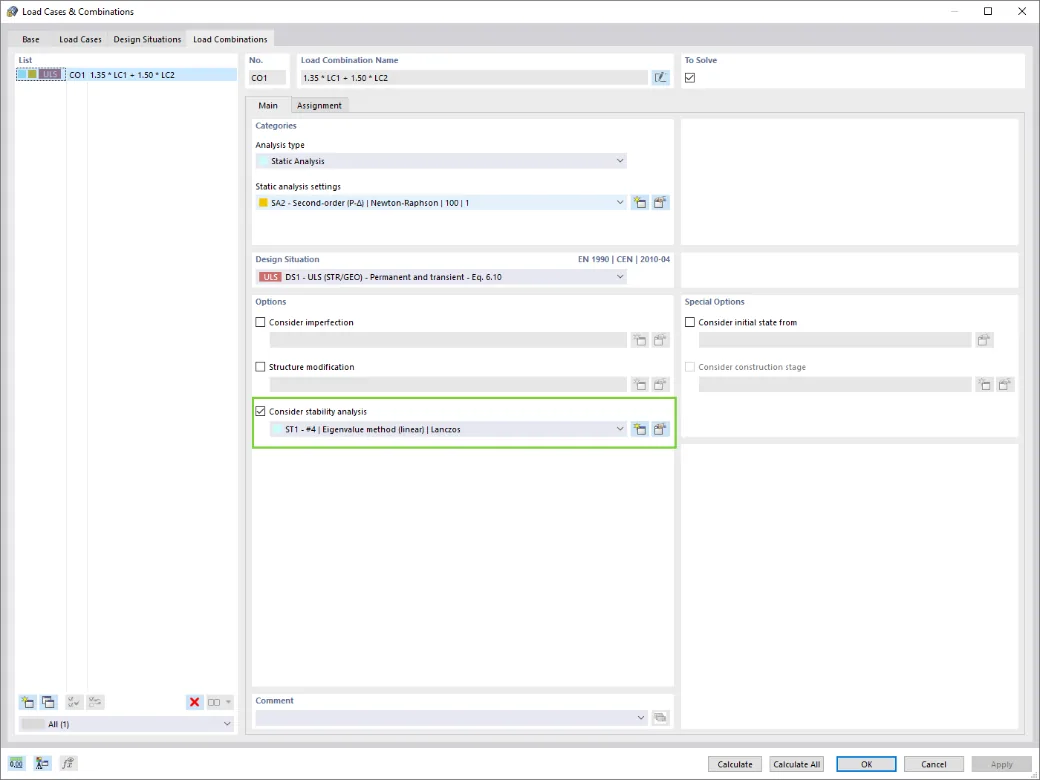
The calculation is switched on as a property of a load case or load combination, and through the combination wizards for several situations at once. You can include axial forces from initial prestress via another load case, consider stiffness modifications, and divide members automatically so that their local buckling is also found. The Shift method finds modes above a load factor you set, and for unstable models you can view the mode shapes to locate the cause.
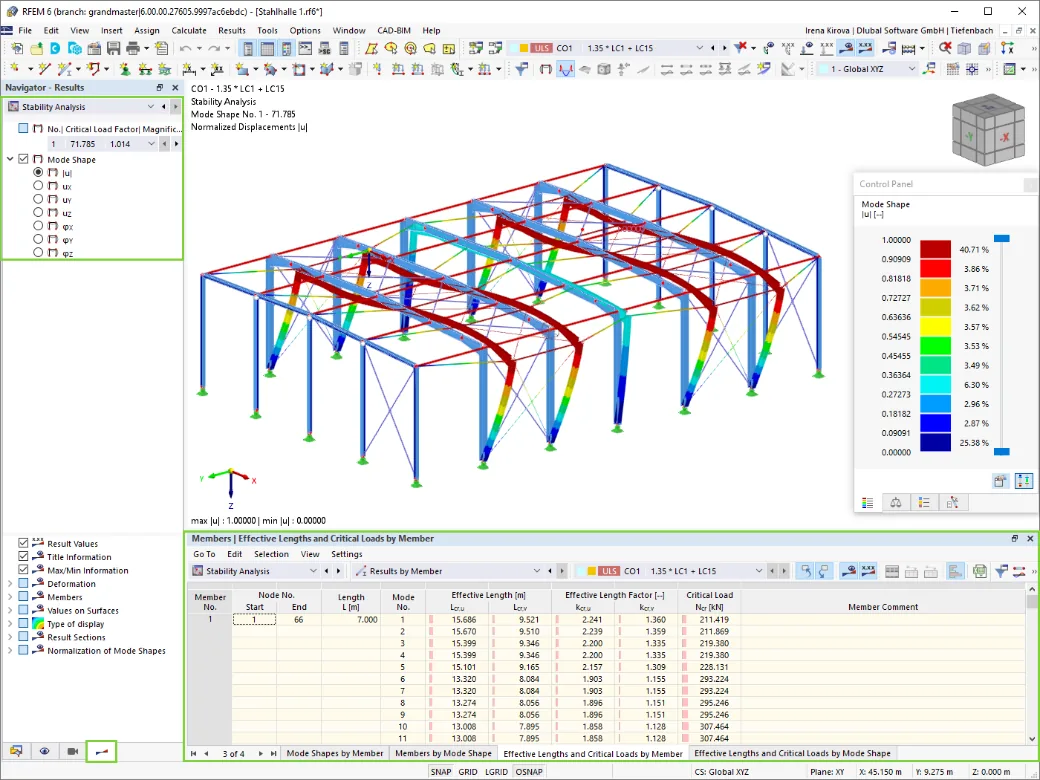
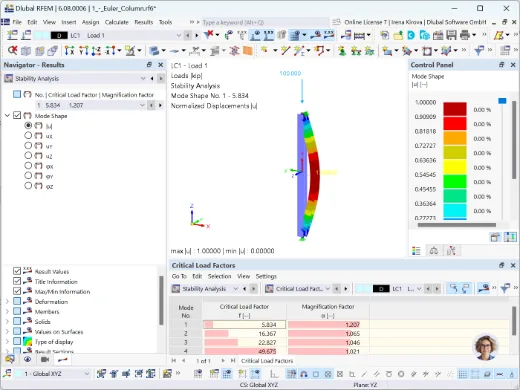
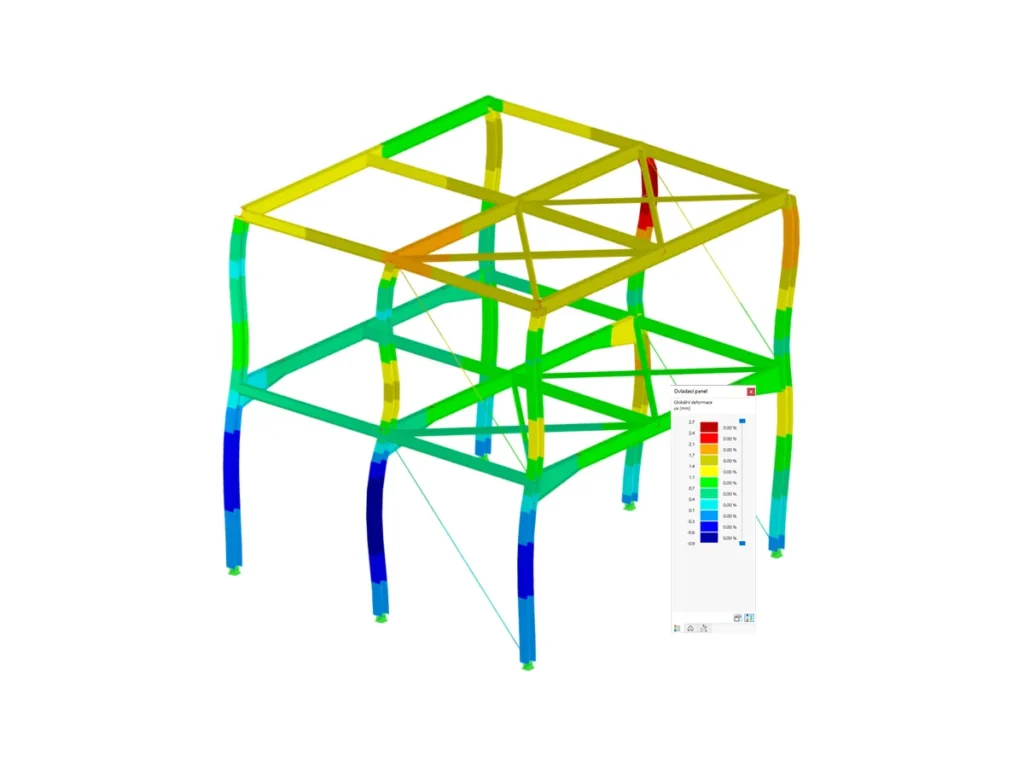
The first results are the critical load factors and, in tables, the effective lengths and critical loads of the members. They are followed by normalised mode shapes by node and member, member results per mode shape (local deformations, internal forces, strains) and the modal relevance factor, which shows how much each member takes part in a mode. The buckling mode is shown graphically and serves as a basis for defining imperfections.
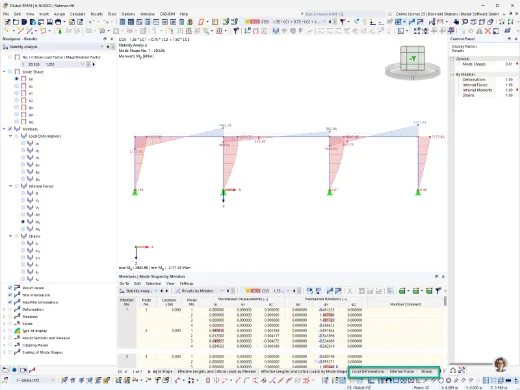
Features
Features
- Methods
- eigenvalue and incremental (nonlinear)
- Eigenvalue solvers
- Subspace Iteration, Shifted Inverse Iteration
- Activation
- in a load case or combination, and via combination wizards
- Prestress
- axial forces from initial prestress
- Stiffness
- modifications via the structure modification settings
- Shift method
- modes above a load factor you set
- Results
- critical load factors, effective lengths, critical member loads
- Modal relevance factor
- share of each member in each mode shape
- Imperfections
- the buckling mode as a basis for imperfections
All features
- Stability analysis with the eigenvalue method and with the incremental (nonlinear) method
- Optional consideration of axial forces from initial prestress
- Eigenvalue solvers in RSTAB: Subspace Iteration and Shifted Inverse Iteration
- Optional consideration of stiffness modifications via the structure modification settings
- Determination of a buckling mode above a user-defined load factor (Shift method)
- Optional calculation of mode shapes for unstable models, to locate the cause of instability
- Automatic division of members, so that their local buckling is also found
- Incremental load increase up to instability, with nonlinearities (members, supports, foundations, material) and user-defined termination criteria
- Optional linear stability analysis on the last stable state, to obtain the stability mode
- Critical load factors, plus effective lengths and critical loads of members in tables
- Normalised mode shapes by node and member, with the normalisation changeable without recalculation
- Member results per mode shape: local deformations, internal forces and strains, in graphics and tables
- Modal relevance factor (MRF) to tell local from global buckling modes
- Graphical display of the buckling mode, as a basis for defining imperfections
- Activation as a property of a load case or combination, and in bulk via the combination wizards
- Result tables with filter option
- Combination with the Torsional Warping (7 DOF) add-on, for cross-section warping in the stability analysis
System requirements
Operating system Windows
- Requires an RSTAB 9 licence
- For cross-section warping in the stability analysis: the Torsional Warping (7 DOF) add-on
Works well with, and alternatives
Works well with

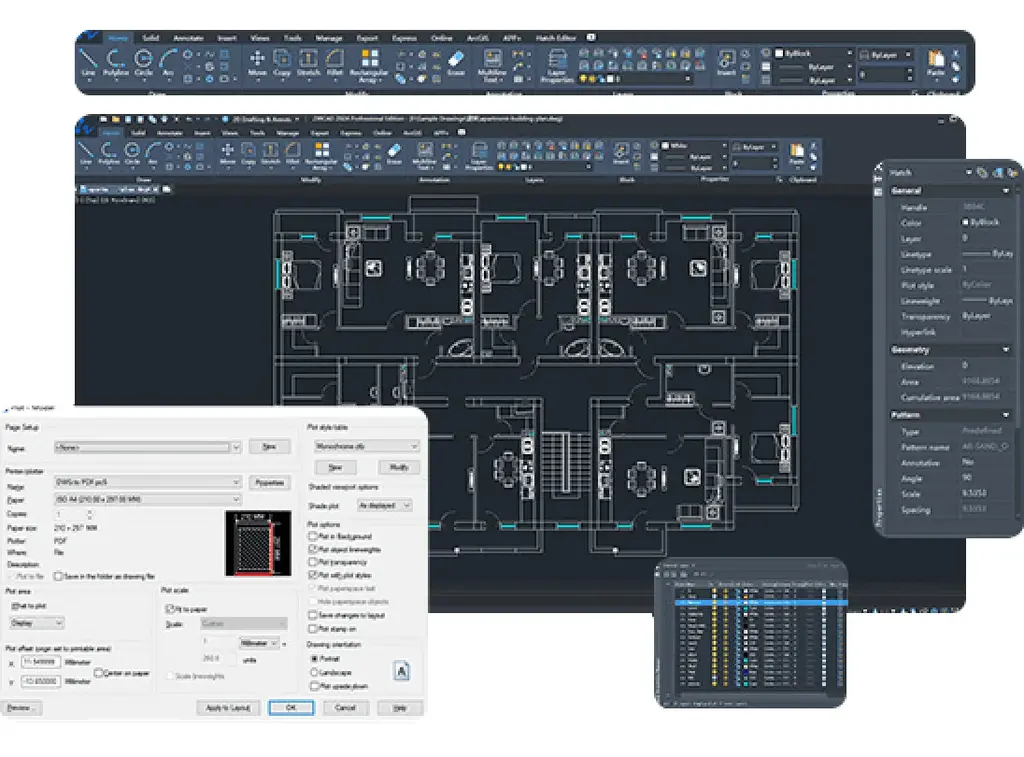
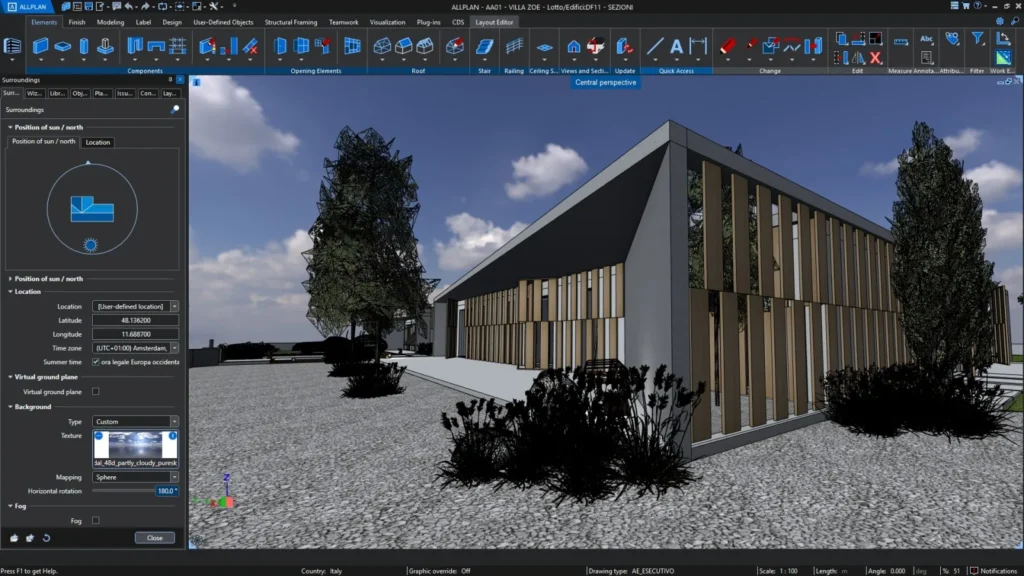
Alternatives
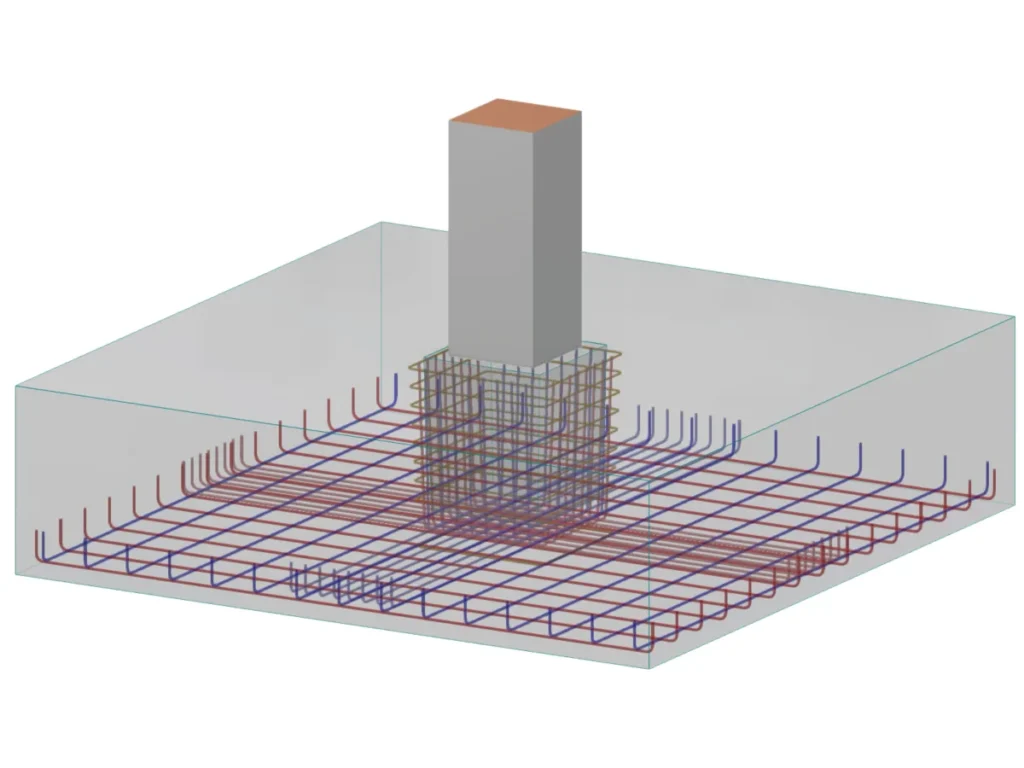
from Was 1.250 € 875 € per year, excl. VAT
from Was 1.350 € 945 € per year, excl. VAT
from Was 1.650 € 1.155 € per year, excl. VAT
Structure Stability for RSTAB 9 next to alternatives
Open the full comparisonQuestions, licence and delivery
What do I need to run it?
An RSTAB 9 licence. Structure Stability is an add-on of RSTAB 9 and analyses the same model.
What does it calculate?
The critical load factors and the corresponding stability modes. For members it also gives effective lengths and critical loads.
Does it perform nonlinear stability analysis?
Yes, with the incremental method: loads are raised step by step until instability, with nonlinearities such as failing members, supports and foundations.
Which eigenvalue solvers are available in RSTAB?
Subspace Iteration and Shifted Inverse Iteration.
Does it find local buckling of single members?
Yes, if you activate the automatic division of members. Without it, a member with two nodes does not show its local buckling.
Can I buy or rent it?
Both: it is available as a perpetual licence or for rent for 1, 3, 6 or 12 months.
How do I receive the licence?
After payment we order the licence from the manufacturer and email you its details.
Do the prices include VAT?
Prices exclude VAT. With a valid VAT number from another EU country, VAT is not charged; in Belgium it is charged at 21%. For private customers, VAT is calculated at checkout.