
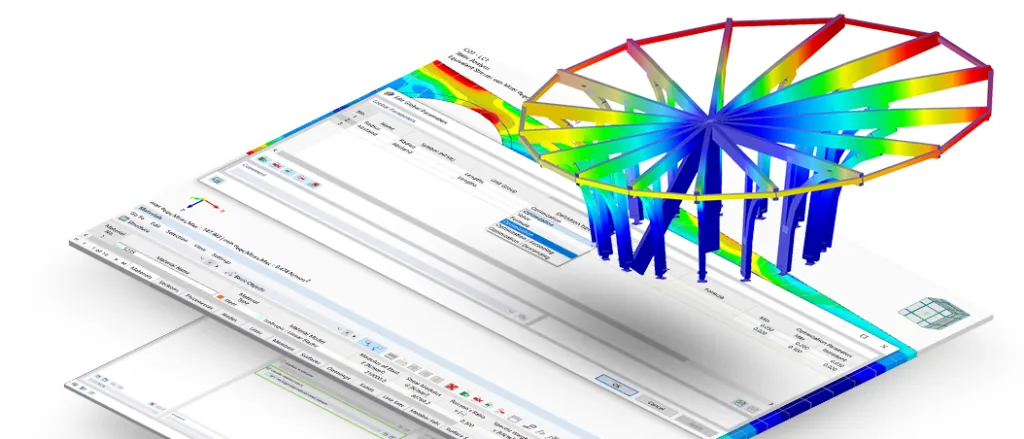
Optimization & Costs / CO2 Emission Estimation for RSTAB 9
by Dlubal, Structural analysis
Optimisation of parametric member models in RSTAB 9 with particle swarm (AI)
RSTAB 9 and its add-ons
RSTAB 9 is the main program for beams, frames and trusses; the add-ons are bought separately, whenever you need them. Click an add-on to see what it does and its price.
Main programs 1
-
RSTAB 9
Structural analysis of frames and trusses for civil engineers
from 2.345 € per year
- Structures: bars, frames, trusses
- Analysis: linear and non-linear
- Design: with add-ons
Design 6
-
Steel Design
Strength, stability and serviceability checks of steel members in RSTAB 9
from 2.065 € per year
- Limit states: ultimate and serviceability
- Standards: Eurocode 3 and other international standards, e.g. AISC 360
- Sections: rolled, hollow, parametric, built-up, from RSECTION
-
Stress-Strain Analysis
Stress analysis of RSTAB 9 members against limit stresses
from 945 € per year
- Objects: members and member sets
- Stresses: normal, shear, equivalent
- Limit stress: from the material or user-defined, also by sign
-
Concrete Design
Reinforced concrete in RSTAB 9: beams, columns and member sets
from 2.065 € per year
- Elements: members and member sets: beams and columns
- Limit states: ultimate and serviceability, with detailing rules
- Reinforcement: longitudinal, transverse and torsional per member
-
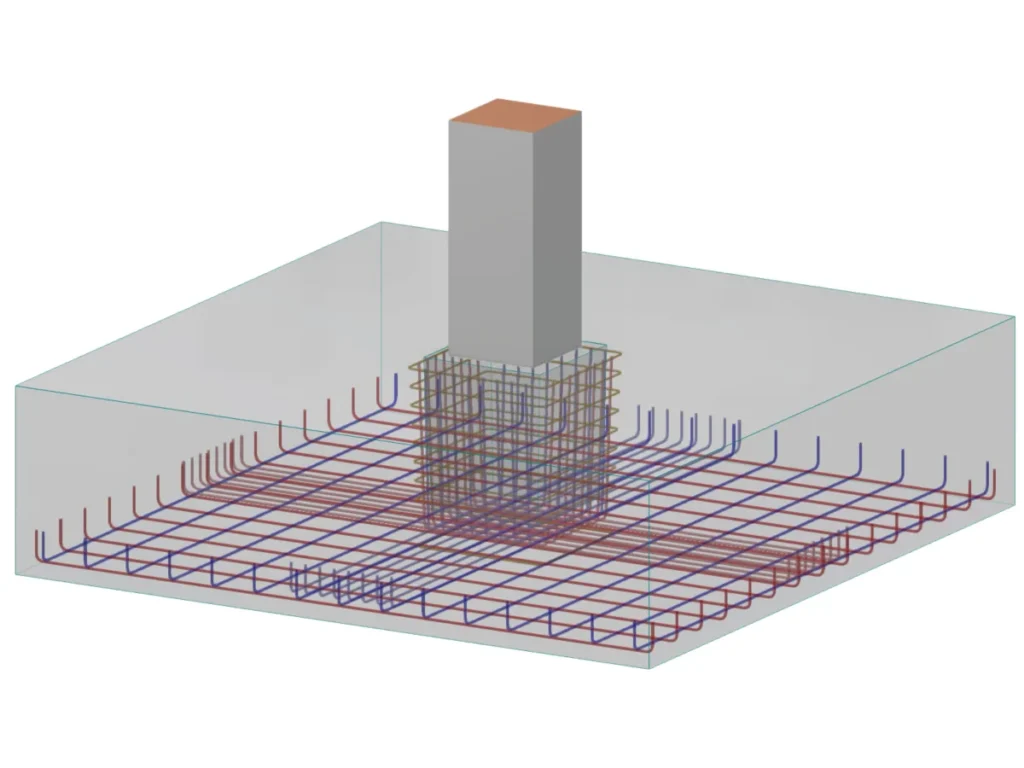
Concrete Foundations
Geotechnical checks and design of concrete foundations inside RSTAB 9
from 875 € per year
- Foundation types: reinforced and unreinforced plates, bucket, block, stepped
- Bucket sides: smooth or rough
- Geotechnical checks: bearing capacity, sliding, uplift, overturning
-
Aluminum Design
Strength, stability and serviceability checks of aluminium members in RSTAB 9
from 1.365 € per year
- Limit states: ultimate and serviceability
- Standards: various, including ADM
- Sections: rolled, hollow, parametric, built-up, RSECTION
-
Timber Design
Strength, stability, serviceability and fire checks of timber members in RSTAB 9
from 1.505 € per year
- Limit states: ultimate, serviceability and fire
- Standards: EN 1995, AS 1720, GB 50005 and others
- Sections: rectangular, circular, T, built-up, parametric
Dynamic analysis 4
-
Modal Analysis
Natural frequencies, periods and mode shapes of frame structures in RSTAB 9
from 945 € per year
- Program: RSTAB 9 (add-on)
- Solvers: Subspace Iteration, shifted inverse power method
- Eigenvalues: up to 9,999
-
Response Spectrum Analysis
Seismic analysis with response spectra and equivalent static loads in RSTAB 9
from 1.085 € per year
- Program: RSTAB 9 (add-on)
- Method: multi-modal response spectrum analysis
- Codes: EN 1998-1 (25+ National Annexes, incl. ELOT), ASCE 7, NBC, SIA 261 and others
-
Time History Analysis
Dynamic analysis in the time domain for time diagrams and earthquakes in RSTAB 9
from 1.015 € per year
- Program: RSTAB 9 (add-on)
- Excitation: force-time diagrams, support accelerograms
- Linear solvers: linear modal, linear implicit Newmark
-
Pushover Analysis
Pushover analysis in RSTAB 9: capacity curve and target displacement to EC 8
from 1.015 € per year
- Program: RSTAB 9 (add-on)
- Plastic hinges: steel to FEMA 356 and EN 1998-3
- Nonlinear material: masonry, bilinear steel, your own diagrams
Additional analyses 2
-
Structure Stability
Critical load factors and buckling modes of member structures in RSTAB 9
from 1.015 € per year
- Methods: eigenvalue and incremental (nonlinear)
- Eigenvalue solvers: Subspace Iteration, Shifted Inverse Iteration
- Activation: in a load case or combination, and via combination wizards
-
Torsional Warping (7 DOF)
Cross-section warping as a 7th degree of freedom in RSTAB 9 member analysis
from 1.225 € per year
- Degrees of freedom: 7 (ux, uy, uz, φx, φy, φz, ω)
- Internal forces: 8, including Mt,pri, Mt,sec and bimoment Mω
- Analyses: linear static, second-order, large deformation
Special solutions 1
-
Optimization & Costs / CO2
Optimisation of parametric member models in RSTAB 9 with particle swarm (AI)
from 1.155 € per year
- Program: RSTAB 9 (add-on)
- Methods: particle swarm optimization (PSO), batch processing
- Criteria: minimum weight or minimum deformation
First-licence prices for Greece and Cyprus, excluding VAT. The add-ons work inside RSTAB 9.
Let RSTAB try out the variants
You set the ranges, choose a criterion and get back the best variant of the model.
What changes, and within which limits
You activate the add-on in the model, and the parametric model or block is controlled by global parameters of the “optimization” type.
- Lower and upper limit and step size for every parameter
- As many parameters as you need, for example for cross-sections and materials
- Parameter definition in ascending or descending order
- Blocks parametrised with JavaScript code as well


Particle swarm or batch processing
You choose a criterion and a method, and the search runs alongside the normal calculation.
- Criterion of minimum weight or minimum deformation
- PSO, the fastest method, which builds on the previous variants
- Batch processing with random values up to the number of variants you set
- Design results checked after every variant


The best solution in the first row
Only variants with a utilisation below 1 are kept.
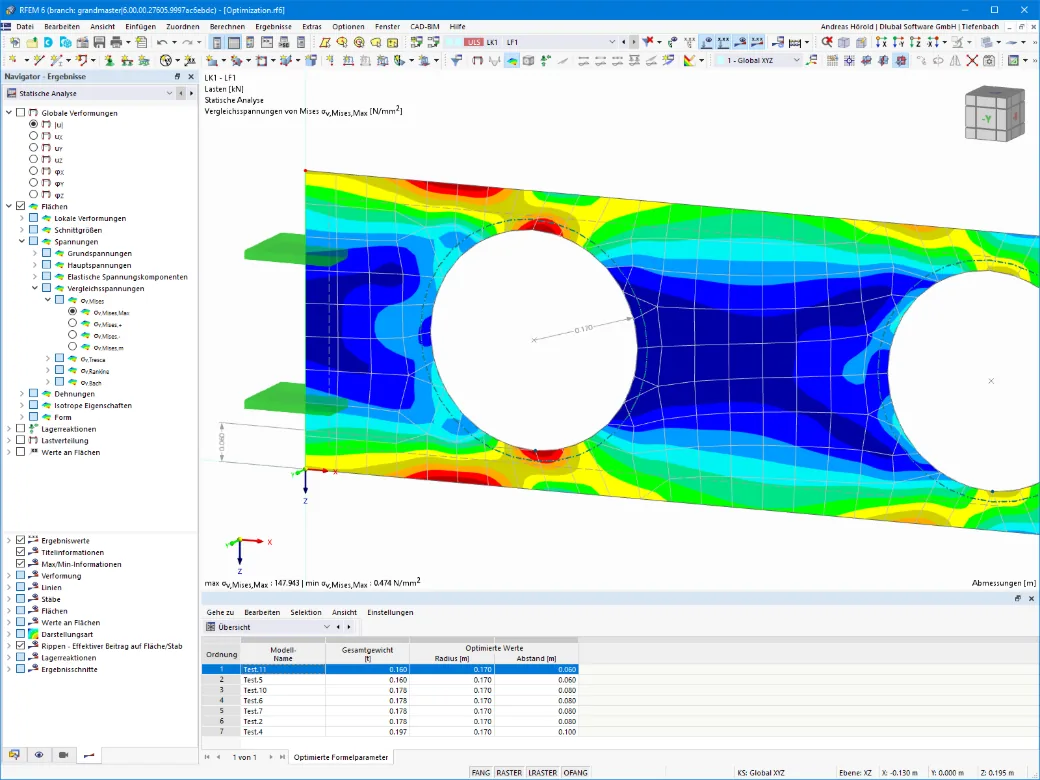
- Table of the best model variants
- Real-time display of the variants during the calculation
- The values of the optimal solution move to the global parameters automatically

What it does, stage by stage
The Optimization & Costs / CO2 Emission Estimation for RSTAB 9 add-on, which Dlubal presents on its page as Model Optimization for RSTAB 9, helps you plan more economically and sustainably. It finds suitable parameter values for parametric models and blocks using particle swarm optimization (PSO), an artificial intelligence technology, so that the usual optimisation criteria are met.
Optimisation complements parametric input and runs alongside the normal calculation and design of the model. The model or block is controlled by global parameters of the “optimization” type, each with a lower and upper limit and a step size. You define as many parameters as you need, for example for cross-sections and materials, and choose a criterion, minimum weight or minimum deformation. Blocks can also be parametrised with JavaScript code.
There are two methods. PSO is the most efficient, with the shortest calculation time: it starts from random values and tries new model variants based on the experience of the previous ones. Alternatively, batch processing assigns random values to the parameters until the number of variants you set is reached. After each variant both methods check the active design results of the add-ons and keep only solutions with a utilisation below 1.
At the end you get a table of the best variants, with the one closest to the criterion in the first row, and during the run you see the variants in real time. The program automatically transfers the values of the optimal solution to the model's global parameter list.
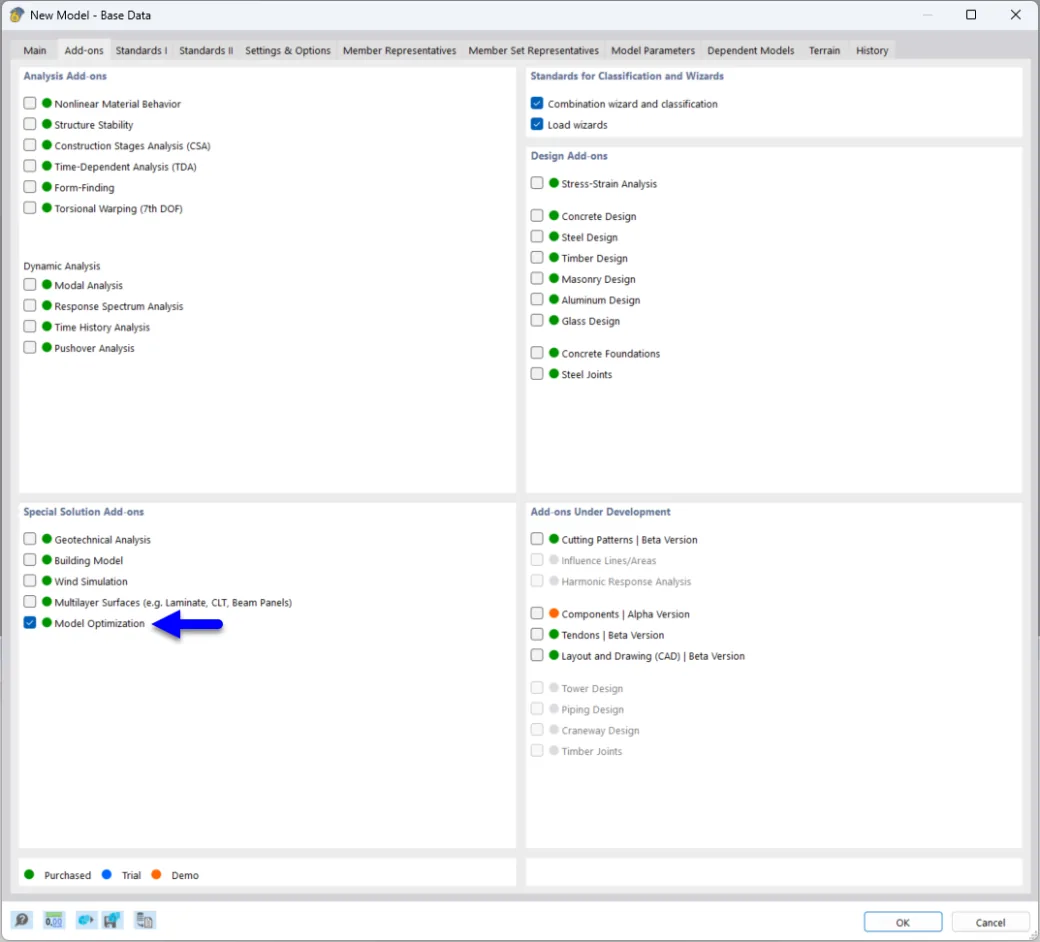
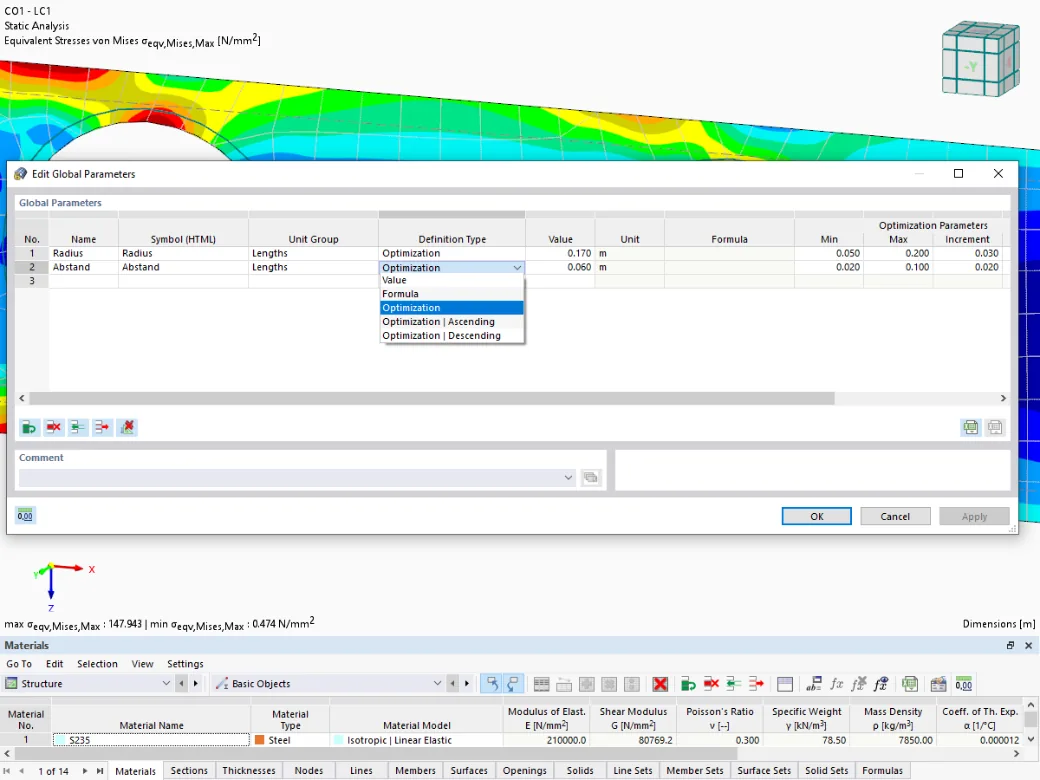
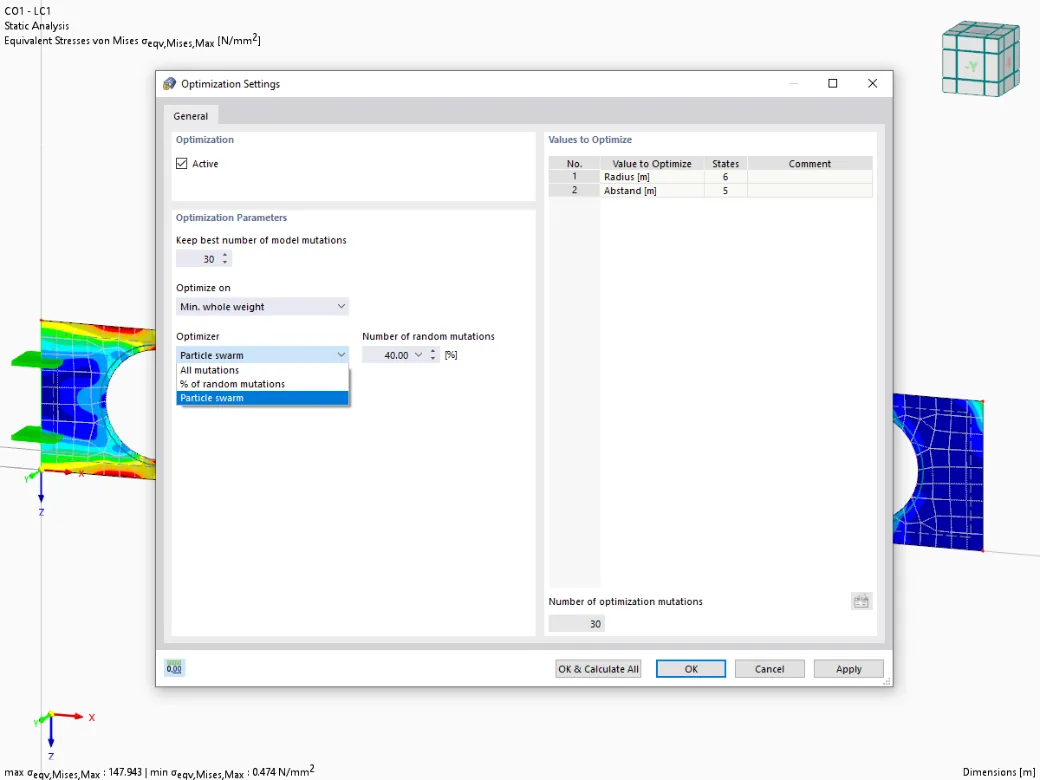
Features
Features
- Program
- RSTAB 9 (add-on)
- Methods
- particle swarm optimization (PSO), batch processing
- Criteria
- minimum weight or minimum deformation
- Parameters
- as many as needed, with limits and step size
- What is optimised
- cross-sections, materials and other model parameters
- Models
- parametric models and blocks, also with JavaScript
- Design
- design results are taken into account
- Results
- table of best variants, real-time display
All features
- Artificial intelligence (AI) technology: particle swarm optimization (PSO)
- Structural optimisation for minimum weight or minimum deformation
- Any number of optimisation parameters
- Value ranges defined with lower and upper limit and step size
- Optimisation of cross-sections and materials
- Parameter definition types Optimization | Ascending or Optimization | Descending
- Application to parametric models and blocks
- Code-based JavaScript parametrisation of blocks
- Optimisation taking the design results into account
- Alternative batch processing method with random parameter values
- Storage of the variants with utilisation < 1, together with the result and the parameter values
- Real-time display of the model variants during optimisation
- Table of the best model variants, with the best solution in the first row
- Automatic application of the optimal values to the global parameter list after the analysis
System requirements
Operating system Windows
- Requires an RSTAB 9 licence
- The model or block must be parametric, with global parameters of the “optimization” type
Works well with, and alternatives
Works well with

Alternatives
from Was 1.950 € 1.365 € per year, excl. VAT
from Was 1.250 € 875 € per year, excl. VAT
from Was 1.350 € 945 € per year, excl. VAT
Optimization & Costs / CO2 Emission Estimation for RSTAB 9 next to alternatives
Open the full comparisonQuestions, licence and delivery
What does it optimise?
The values of the global parameters of a parametric RSTAB 9 model or block, such as cross-sections and materials, to find the solution with minimum weight or minimum deformation.
Which methods are available?
Particle swarm optimization (PSO), the most efficient one, and batch processing with random parameter values.
Are the design checks taken into account?
Yes. After each variant the active design results of the add-ons are checked, and only solutions with a utilisation below 1 are kept.
What does my model need?
It must be parametric and controlled by global parameters of the “optimization” type, with a lower and upper limit and a step size.
How do I get the optimal solution?
At the end a table of the best variants appears, and the program automatically transfers the values of the best one to the global parameter list.
Can I buy or rent it?
Both: it is available as a perpetual licence or for rent for 1, 3, 6 or 12 months.
How do I receive the licence?
After payment we order the licence from the manufacturer and email you its details.
Do the prices include VAT?
Prices exclude VAT. With a valid VAT number from another EU country, VAT is not charged; in Belgium it is charged at 21%. For private customers, VAT is calculated at checkout.