
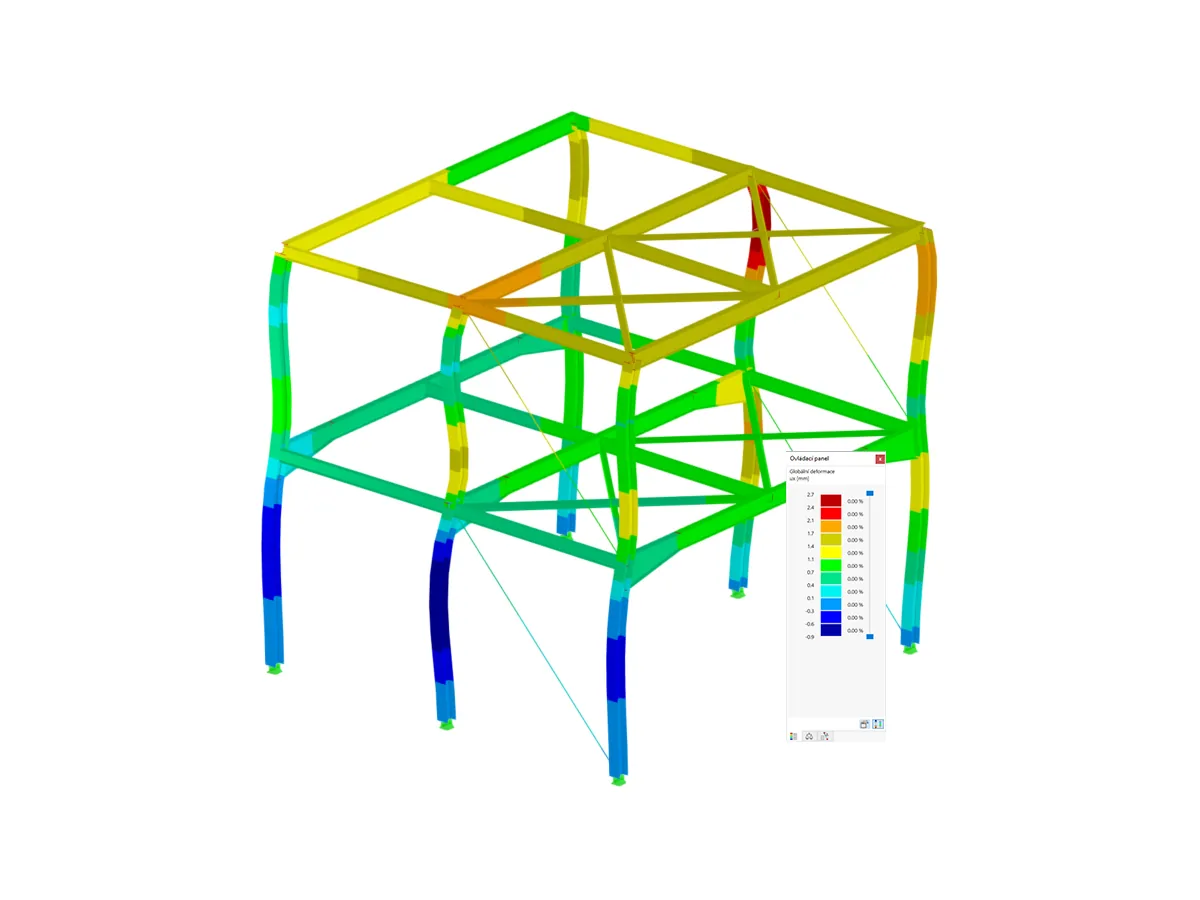
Modal Analysis for RSTAB 9
by Dlubal, Structural analysis
Natural frequencies, periods and mode shapes of frame structures in RSTAB 9
RSTAB 9 and its add-ons
RSTAB 9 is the main program for beams, frames and trusses; the add-ons are bought separately, whenever you need them. Click an add-on to see what it does and its price.
Main programs 1
-
RSTAB 9
Structural analysis of frames and trusses for civil engineers
from 2.345 € per year
- Structures: bars, frames, trusses
- Analysis: linear and non-linear
- Design: with add-ons
Design 6
-
Steel Design
Strength, stability and serviceability checks of steel members in RSTAB 9
from 2.065 € per year
- Limit states: ultimate and serviceability
- Standards: Eurocode 3 and other international standards, e.g. AISC 360
- Sections: rolled, hollow, parametric, built-up, from RSECTION
-
Stress-Strain Analysis
Stress analysis of RSTAB 9 members against limit stresses
from 945 € per year
- Objects: members and member sets
- Stresses: normal, shear, equivalent
- Limit stress: from the material or user-defined, also by sign
-
Concrete Design
Reinforced concrete in RSTAB 9: beams, columns and member sets
from 2.065 € per year
- Elements: members and member sets: beams and columns
- Limit states: ultimate and serviceability, with detailing rules
- Reinforcement: longitudinal, transverse and torsional per member
-
Concrete Foundations
Geotechnical checks and design of concrete foundations inside RSTAB 9
from 875 € per year
- Foundation types: reinforced and unreinforced plates, bucket, block, stepped
- Bucket sides: smooth or rough
- Geotechnical checks: bearing capacity, sliding, uplift, overturning
-
Aluminum Design
Strength, stability and serviceability checks of aluminium members in RSTAB 9
from 1.365 € per year
- Limit states: ultimate and serviceability
- Standards: various, including ADM
- Sections: rolled, hollow, parametric, built-up, RSECTION
-
Timber Design
Strength, stability, serviceability and fire checks of timber members in RSTAB 9
from 1.505 € per year
- Limit states: ultimate, serviceability and fire
- Standards: EN 1995, AS 1720, GB 50005 and others
- Sections: rectangular, circular, T, built-up, parametric
Dynamic analysis 4
-
Modal Analysis
Natural frequencies, periods and mode shapes of frame structures in RSTAB 9
from 945 € per year
- Program: RSTAB 9 (add-on)
- Solvers: Subspace Iteration, shifted inverse power method
- Eigenvalues: up to 9,999
-
Response Spectrum Analysis
Seismic analysis with response spectra and equivalent static loads in RSTAB 9
from 1.085 € per year
- Program: RSTAB 9 (add-on)
- Method: multi-modal response spectrum analysis
- Codes: EN 1998-1 (25+ National Annexes, incl. ELOT), ASCE 7, NBC, SIA 261 and others
-
Time History Analysis
Dynamic analysis in the time domain for time diagrams and earthquakes in RSTAB 9
from 1.015 € per year
- Program: RSTAB 9 (add-on)
- Excitation: force-time diagrams, support accelerograms
- Linear solvers: linear modal, linear implicit Newmark
-
Pushover Analysis
Pushover analysis in RSTAB 9: capacity curve and target displacement to EC 8
from 1.015 € per year
- Program: RSTAB 9 (add-on)
- Plastic hinges: steel to FEMA 356 and EN 1998-3
- Nonlinear material: masonry, bilinear steel, your own diagrams
Additional analyses 2
-
Structure Stability
Critical load factors and buckling modes of member structures in RSTAB 9
from 1.015 € per year
- Methods: eigenvalue and incremental (nonlinear)
- Eigenvalue solvers: Subspace Iteration, Shifted Inverse Iteration
- Activation: in a load case or combination, and via combination wizards
-
Torsional Warping (7 DOF)
Cross-section warping as a 7th degree of freedom in RSTAB 9 member analysis
from 1.225 € per year
- Degrees of freedom: 7 (ux, uy, uz, φx, φy, φz, ω)
- Internal forces: 8, including Mt,pri, Mt,sec and bimoment Mω
- Analyses: linear static, second-order, large deformation
Special solutions 1
-
Optimization & Costs / CO2
Optimisation of parametric member models in RSTAB 9 with particle swarm (AI)
from 1.155 € per year
- Program: RSTAB 9 (add-on)
- Methods: particle swarm optimization (PSO), batch processing
- Criteria: minimum weight or minimum deformation
First-licence prices for Greece and Cyprus, excluding VAT. The add-ons work inside RSTAB 9.
How your frame structure vibrates
Choose a topic and see where the masses come from, how the solution works and what you get at the end.
Masses come from your load cases
No need to enter loads again: masses come from self-weight and from the load cases and combinations of the model.
- Total mass, Z component or only in the direction of gravity
- Additional masses at nodes, lines and members, plus inertia masses
- Exclusion of masses, e.g. of the foundations
- Preset combination coefficients for EC 8, SIA 261, ASCE 7 and others


Two solvers and an automatic number of modes
You pick a solver to suit the size of the model and let the add-on find how many mode shapes are needed.
- Subspace Iteration or shifted inverse power method
- Up to 9,999 eigenvalues
- Automatic up to an effective modal mass factor or a maximum natural frequency
- Structure modification, initial states and several analyses in one model


Animated mode shapes and full tables
Each mode shape is shown in the model, still or animated, with its numbers alongside in tables.
- Eigenvalue, angular frequency, natural frequency and period
- Effective modal masses, mass factors and participation factors
- Animation and scaling options for mode shapes
- Printout report and export of tables to MS Excel


Dynamic and seismic analysis in RFEM 6 and RSTAB 9
Official Dlubal video on the dynamic analysis of structures.

See it in action
The video or demo loads only when you press play.
What it does, stage by stage
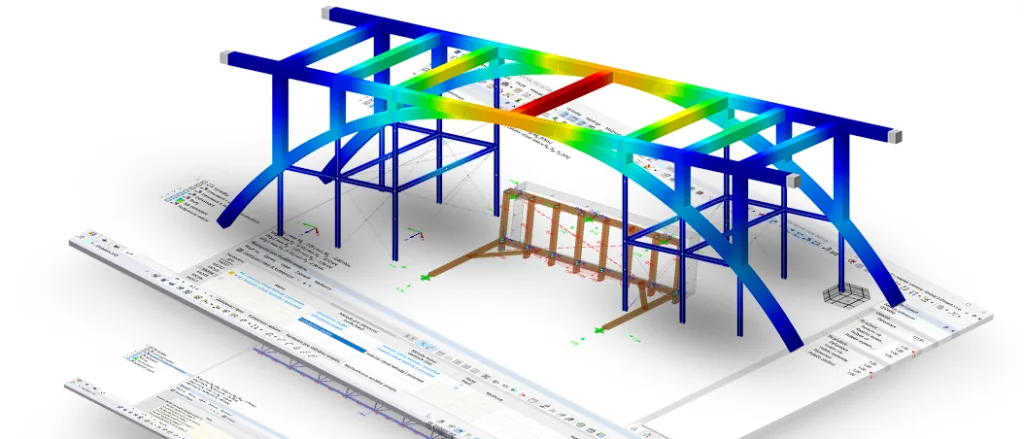
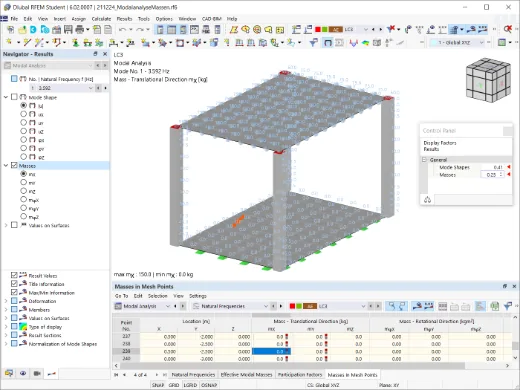
The Modal Analysis for RSTAB 9 add-on calculates the eigenvalues, natural frequencies and natural periods of your structure, together with its mode shapes. All input comes directly from the RSTAB model, and you can request up to 9,999 eigenvalues.
Masses are taken automatically from self-weight or imported from load cases and load combinations: as the total mass, as the component in the global Z direction, or only in the direction of gravity. You add masses at nodes, lines and members, leave out masses such as those of foundations, and use preset combination coefficients for standards such as EC 8, SIA 261 and ASCE 7. Stiffness can be influenced by axial forces, stiffness modifications, initial states (e.g. prestress and imperfections) or failed supports and members.
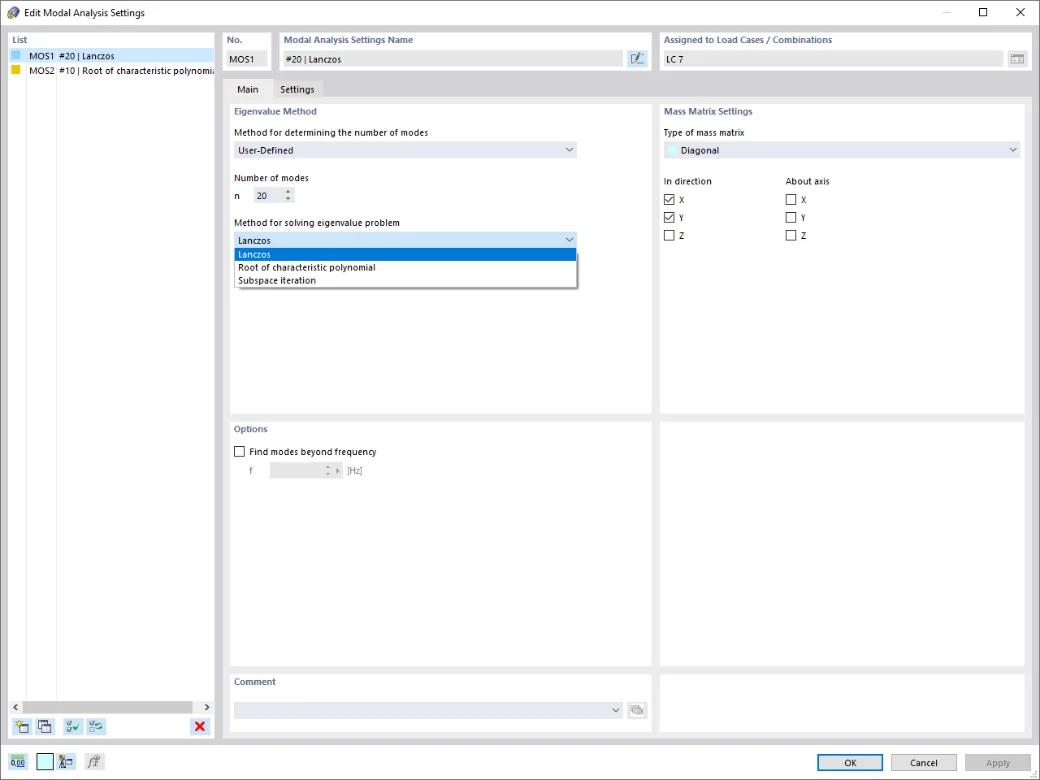
RSTAB offers two eigenvalue solvers, Subspace Iteration and the shifted inverse power method; the choice depends mainly on the size of the model. You set the number of mode shapes yourself or let the add-on find it, so that you reach an effective modal mass factor, e.g. the 90% required by the response spectrum method, or a maximum natural frequency, an option available only in RSTAB.
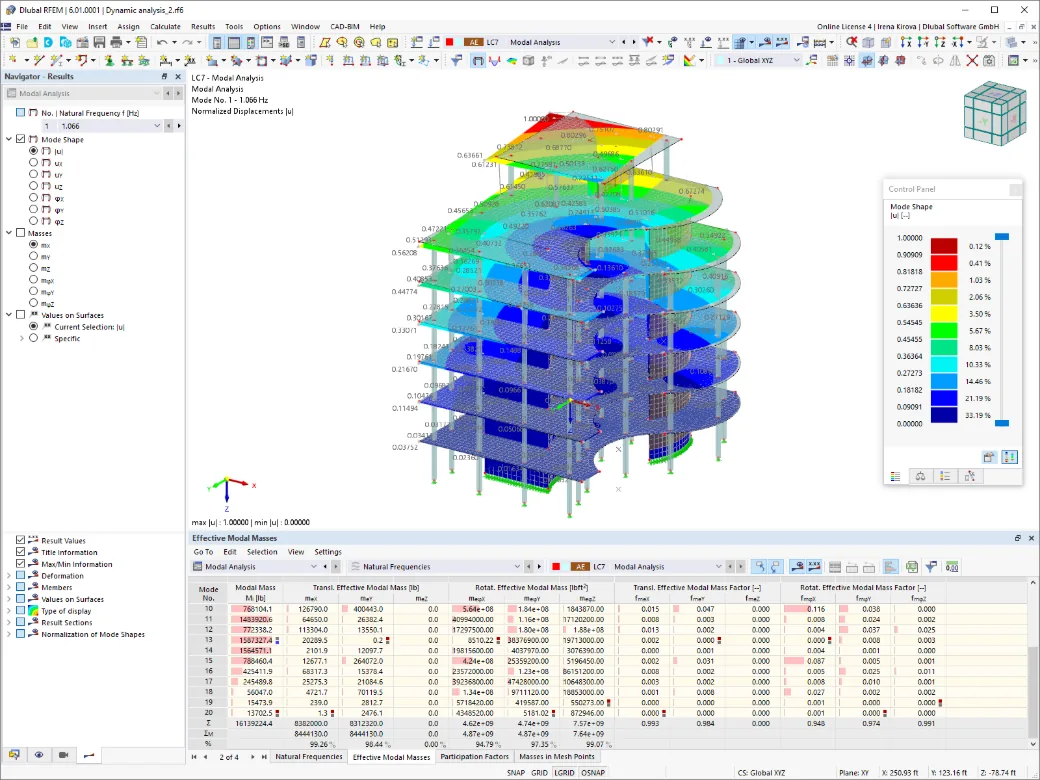
You get eigenvalue, angular frequency, natural frequency and period, modal and effective modal masses, modal mass factors and participation factors. Mode shapes are shown in tables and graphics, animated and scaled, and all results go into the printout report or can be exported to MS Excel. Modal analysis is the basis for the Response Spectrum Analysis add-on.
Features
Features
- Program
- RSTAB 9 (add-on)
- Solvers
- Subspace Iteration, shifted inverse power method
- Eigenvalues
- up to 9,999
- Results
- eigenvalue, angular frequency, natural frequency, period
- Masses
- self-weight, load cases and combinations, additional masses
- Mass matrix
- diagonal, consistent or unit
- Number of modes
- by you or automatic (mass factor, maximum frequency)
- Participation
- effective modal masses, participation factors
- Documentation
- printout report, export to MS Excel
All features
- Automatic consideration of masses from self-weight
- Direct import of masses from load cases or load combinations
- Optional additional masses (nodal, linear and inertia masses) directly in the load cases
- Optional exclusion of masses, for example the mass of foundations
- Combination of masses from different load cases and load combinations
- Preset combination coefficients for various standards (EC 8, SIA 261, ASCE 7 and others)
- Optional import of initial states, e.g. for prestress and imperfections
- Structure modification
- Consideration of failed supports or members
- Several modal analyses in one model, e.g. with different masses or stiffness modifications
- Choice of mass matrix (diagonal, consistent, unit), with your own translational and rotational degrees of freedom
- Number of mode shapes set by the user or automatic, to reach an effective modal mass factor or a maximum natural frequency (the latter only in RSTAB)
- Mode shapes and masses at nodes or mesh points
- Results of eigenvalue, angular frequency, natural frequency and period
- Modal masses, effective modal masses, modal mass factors and participation factors
- Masses at mesh points in tables and graphics
- Display and animation of mode shapes
- Various scaling options for mode shapes
- Numerical and graphical results in the printout report
- RSTAB eigenvalue solvers: Subspace Iteration and shifted inverse power method
- Export of result tables to MS Excel
System requirements
Operating system Windows
- Requires an RSTAB 9 licence
Works well with, and alternatives
Works well with

Alternatives
from Was 1.250 € 875 € per year, excl. VAT
from Was 1.650 € 1.155 € per year, excl. VAT
from Was 1.450 € 1.015 € per year, excl. VAT
Modal Analysis for RSTAB 9 next to alternatives
Open the full comparisonQuestions, licence and delivery
Which eigenvalue solvers does RSTAB 9 offer?
Two: Subspace Iteration and the shifted inverse power method. The choice depends mainly on the size of your model.
How many mode shapes can I calculate?
Up to 9,999 eigenvalues. You set the number yourself or automatically, until you reach an effective modal mass factor or a maximum natural frequency.
Can I leave out masses, e.g. of the foundations?
Yes. Masses can optionally be excluded, and you can also add masses at nodes, lines and members within the load cases.
Can I study the failure of a column?
Yes, with a structure modification: failed supports or members are taken into account, and you define several modal analyses in the same model for comparison.
How are the results used in seismic analysis?
The response spectrum analysis in the Response Spectrum Analysis add-on requires the modal analysis of this add-on.
How is the add-on licensed?
As a perpetual licence or rented for 1, 3, 6 or 12 months. An RSTAB 9 licence is required.
How do I receive the licence?
After payment we order the licence from the manufacturer and email you its details.
Do the prices include VAT?
Prices exclude VAT. With a valid VAT number from another EU country, VAT is not charged; in Belgium it is charged at 21%. For private customers, VAT is calculated at checkout.